
By Cesar Carvajal
Founder / Editor
Cesar Carvajal
•
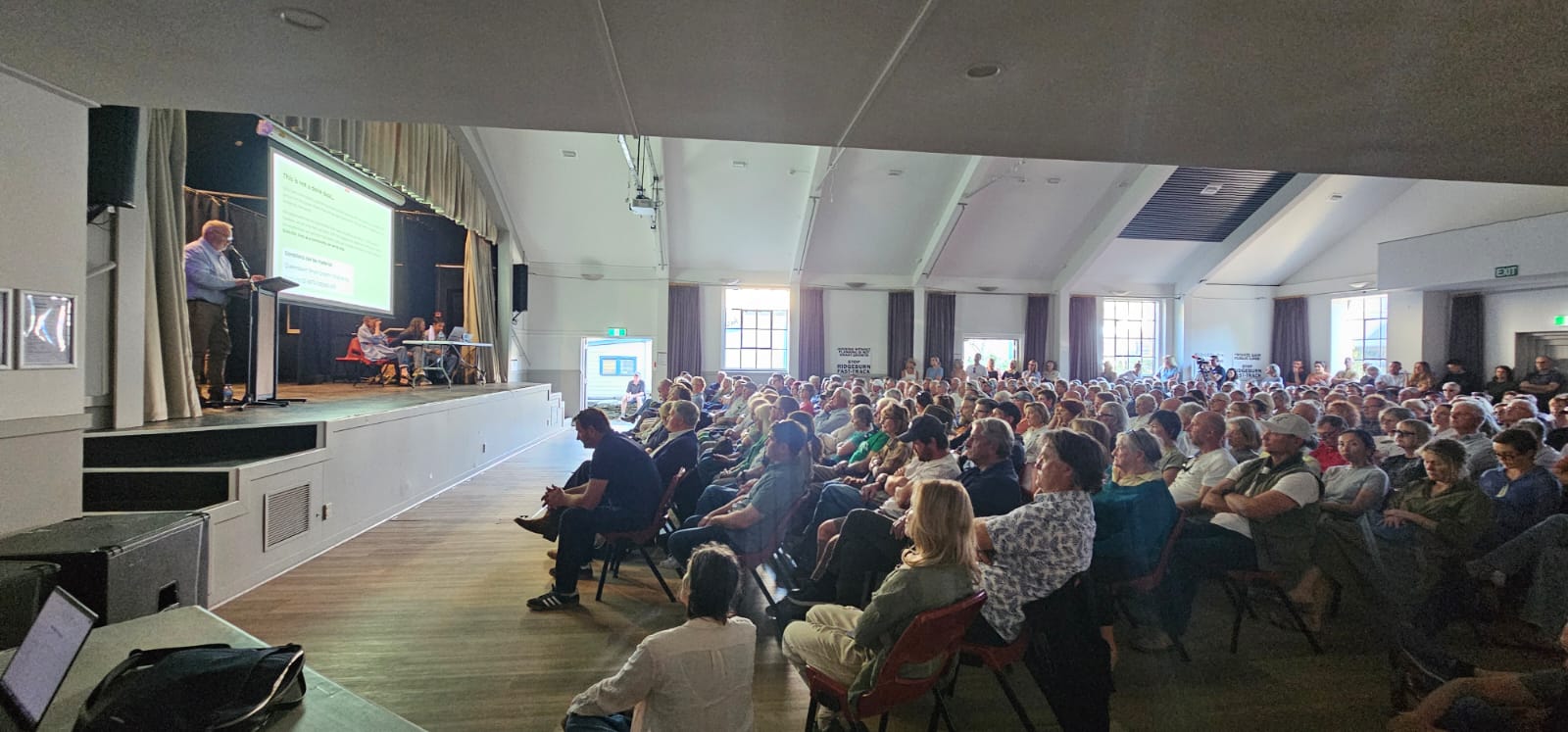
A packed Arrowtown Athenaeum Hall during Monday night’s meeting on residential Fast-track developments. Photo: Queenstowning.
By the time Monday night’s meeting began, the Arrowtown Athenaeum Hall was full. People filled the seats, stood along the walls and gathered around the entrances. At the back of the room, a handmade sign captured the mood: “Housing without planning is not smart growth. Stop Ridgeburn Fast-Track.” Outside, notices around Arrowtown had advertised the meeting under another heading: “About Out of Zone Fast-Tracks.”
The meeting, held on 12 October and organised by the Queenstown Smart Growth Initiative, was promoted as a discussion about residential Fast-track proposals outside the growth areas identified in Queenstown Lakes’ existing Spatial Plan. The organisers’ stated position was not that Queenstown should stop building housing, but that housing should be built where the district has planned for it. And from inside the hall, that distinction mattered.
A room saying no - but not necessarily no to housing
At one point during the meeting, the audience was asked whether it wanted Fast-track housing development of this kind in the region. From Queenstowning’s position inside the hall, the response appeared overwhelmingly - effectively unanimously - no.
That moment was powerful, but it also needs context. This was not a representative poll of the Queenstown Lakes population. It was a public meeting organised by a group concerned about out-of-zone Fast-track development, so people opposed or worried about those developments were naturally more likely to attend. The result cannot tell us what every Queenstown resident thinks, but it does tell us that there is a substantial, organised and highly visible section of the community that believes something is wrong with the way this growth is being pursued.
And the signs in the room suggested the objection was more nuanced than simply saying no to new homes.
The message was: housing needs planning.

A sign inside the meeting framed the opposition as a planning question rather than opposition to housing itself. Photo: Queenstowning.
Queenstown needs housing. But what kind?
There is no serious argument that Queenstown Lakes does not need more housing. QLDC’s latest Housing and Business Capacity Assessment projects that the district will need around 27,100 additional dwellings over the next 30 years, including approximately 9,100 by 2033.
But there is another side of the housing equation that matters just as much: affordability.
Queenstown has spent years being told that increasing housing supply is necessary to address housing pressure. Yet for many people who actually live and work here, the central problem is not simply whether houses exist. It is whether they can afford them. QLDC’s own housing monitoring describes affordability as a major problem. Its published indicators have put the median property price at around $1.33 million, average rent at about $700 a week, and mortgage affordability well beyond what is generally considered affordable. A Queenstown Lakes Community Housing Trust survey also found that 76% of renters surveyed considered affordability a barrier to remaining in the district long term.
That changes the question. More houses may increase overall supply and relieve some pressure over time, but more houses do not automatically mean affordable houses for Queenstown workers. In a destination where land is scarce, domestic and international demand is strong, property values are exceptionally high and houses can function both as homes and investment assets, simply counting new roofs does not tell us who will ultimately be able to live beneath them.
For the community, perhaps the better measure of success is not simply how many houses were consented, but who those houses are actually for.
The planning question
Queenstown already has a framework intended to answer another important question: where should growth happen?
The Queenstown Lakes Spatial Plan was adopted in 2021 following work involving QLDC, central government, Otago Regional Council, Kāi Tahu and public consultation. Its purpose is not simply to draw boundaries on a map. It is intended to coordinate growth with transport, infrastructure, employment, schools, community facilities and services.
For the Wakatipu, the strategy broadly concentrates future urban development along identified corridors rather than spreading residential development throughout the basin. QLDC has subsequently pursued greater intensification within existing urban areas partly because denser development can make infrastructure more efficient and put residents closer to schools, health providers, shops and public transport.
That is why the phrase used repeatedly around Monday’s meeting - “out of zone” - carries weight. The controversy is not simply that houses are being proposed. It is that major residential developments are being proposed in places the existing planning framework did not identify for that level of urbanisation.
And that leads to perhaps the strongest argument heard around the hall:
If Queenstown spent years deciding where growth should happen, what is the value of that planning if major developments can emerge somewhere else through Fast-track?
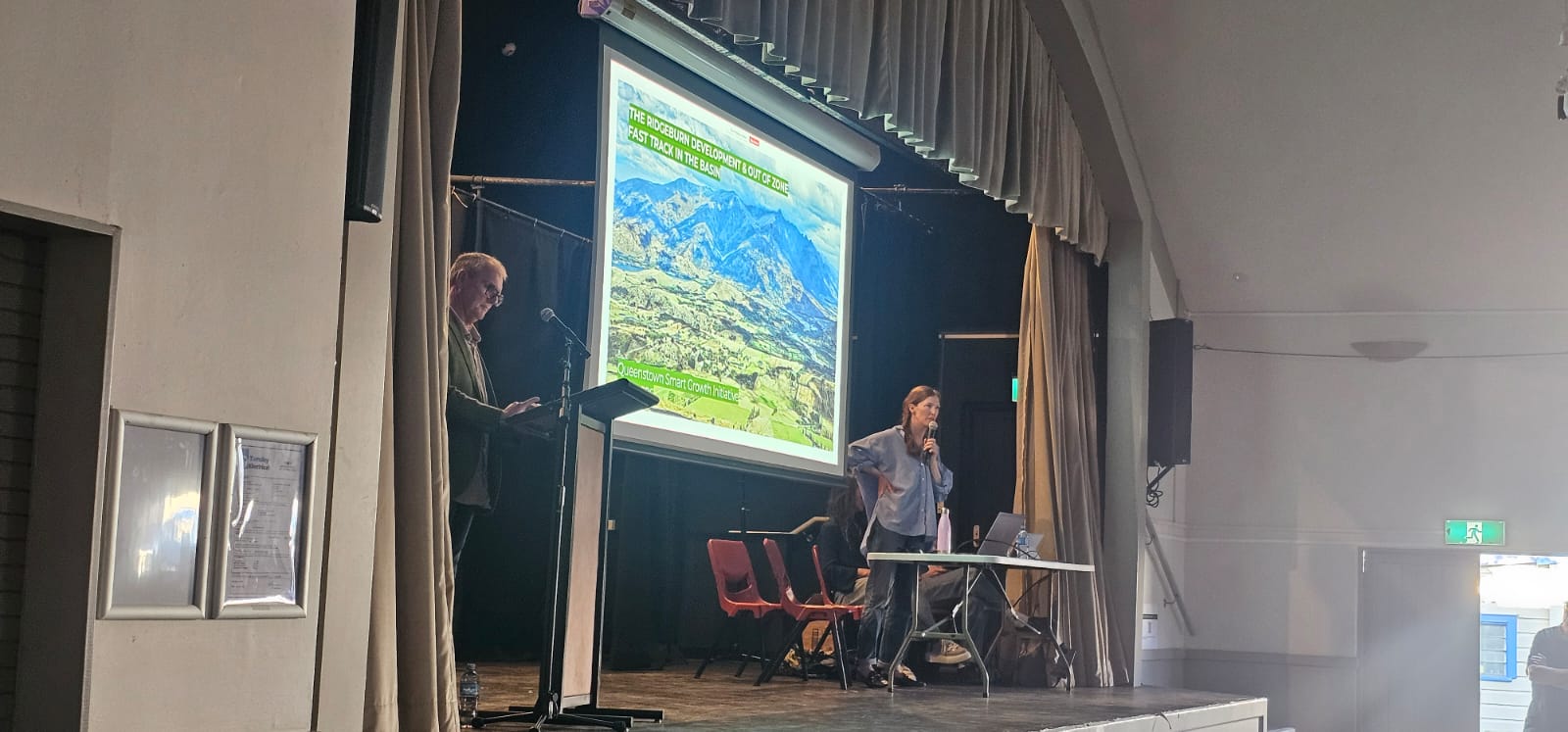
Out-of-zone residential development and Ridgeburn were central themes of Monday night’s presentation. Photo: Queenstowning.
Ridgeburn became the symbol
Much of the opposition has centred on Ridgeburn, at 122 Morven Ferry Road near Arrow Junction. The substantive Fast-track application lodged earlier this year proposed approximately 1,250 dwellings, including 180 designated affordable dwellings, worker accommodation, a commercial village precinct and extensive landscaping.
That application was withdrawn by Ridgeburn Limited on 22 July. As of 13 October, the official Fast-track website still records the substantive application as withdrawn and says the applicant may submit a new application.
The proposal, however, has not disappeared. Developer Kurt Gibbons said in September that a revised version was being prepared, reported at approximately 1,210 homes. He argued Queenstown urgently needs housing and announced additional first-home-buyer initiatives as well as investment towards road and public-transport improvements.
That is an important part of the story. Queenstown has a housing problem, and developers argue that increasing supply must form part of the response. But Monday’s meeting exposed another question that cannot be answered simply by adding up the number of homes proposed:
What happens beyond the boundary of the development?
Infrastructure is more than pipes inside a subdivision
A developer can provide infrastructure within a project. Road connections can be upgraded. Water, wastewater and stormwater systems can be built. Contributions can be made towards transport improvements. But a new community of more than a thousand households does not exist only inside its property boundary.
Its residents drive on the wider road network. Their children attend schools. They use doctors and hospitals. They travel through Frankton. They use public transport. They rely on emergency services, community facilities and regional infrastructure that serves everyone else too. And many of those systems are already under pressure.
The Ministry of Education’s 2026 demand planning says school rolls across the Wakatipu Basin grew 14.1% between 2021 and 2025. It has already approved further classroom expansion and is investigating additional land for another secondary school in Queenstown. Health tells a similar story: QLDC’s latest Quality of Life Survey found 65% of residents reported barriers to accessing healthcare locally, while central government has since announced further health investment for the wider Central Lakes region in response to population growth.
Housing creates communities, and communities require much more than houses.
These are not arguments against housing. They are reminders that the question is not only whether a subdivision can service itself. It is whether Queenstown can service the population that arrives with it.

Questions about roads, schools, healthcare and wider infrastructure featured heavily in concerns around future residential growth. Photo: Queenstowning.
And the problem may already be infrastructure, not simply land
There is another important piece of QLDC’s own housing research. The district already has substantial plan-enabled housing capacity.
QLDC’s 2025 Housing and Business Capacity Assessment found that the immediate housing shortage is significantly connected to infrastructure constraints, particularly in the Whakatipu. The assessment estimated a short-term district-wide shortage of roughly 1,000 dwellings, driven primarily by Whakatipu, where infrastructure-ready capacity was extremely constrained.
That distinction matters. If the obstacle is partly that planned housing cannot yet be serviced with infrastructure, creating additional housing opportunities elsewhere does not necessarily solve the underlying problem. It may simply move the infrastructure question somewhere new.
This is where Monday night’s argument becomes broader than Ridgeburn. Perhaps Queenstown does not only need more housing. Perhaps it needs the roads, schools, healthcare, public transport and three-waters systems that allow already-planned housing to become real communities.
Planned growth versus growth outside the plan
This may ultimately be the clearest way of understanding the disagreement.
It is not simply growth versus no growth, or even housing versus no housing.
It is:
Planned growth versus growth outside the plan.
One approach begins by deciding where thousands of additional residents can live and then tries to coordinate homes with infrastructure, transport, employment and services. The other allows qualifying projects to move through an accelerated national consenting system even when they do not necessarily align with the locally developed spatial framework.
Fast-track applications are decided by independent expert panels, but public participation is narrower than through a conventional notified resource-consent process. The Act does not allow full public or limited notification. Certain organisations and affected parties must be invited to comment, while panels may invite others they consider appropriate. There is no automatic right to a hearing, and appeal rights are largely limited to questions of law.
That helps explain another feature of Monday’s meeting. When people feel they have less opportunity to participate inside a statutory process, they find other places to make themselves heard.
On Monday, that place was the Arrowtown Athenaeum Hall.
The community needs to remain part of the equation
Queenstowning is not approaching this story from the position that every new development should be stopped, nor should one meeting be presented as the voice of every person living in Queenstown Lakes. But local journalism should also not treat the community as something sitting outside the development conversation.
The people in that room live here. They drive these roads, their children attend these schools, they seek medical care in the same health system, they pay rates, and they will live with the consequences of planning decisions long after individual applications have been approved, declined, built or sold.
Their concerns therefore deserve more than a footnote.
This matters particularly for Queenstowning because our purpose is not simply to observe Queenstown from the outside. We are a local publication reporting from within the community that will live with these decisions. That does not mean adopting every position raised in the room. It means taking those concerns seriously enough to investigate them.
Housing for whom?
There is one question Queenstowning thinks deserves much more attention as this debate continues:
When we say Queenstown needs more housing, what exactly do we mean?
Do we mean more houses at whatever price the market will carry? More investment property? More houses for people moving into the district with significant capital? Or homes that the nurses, teachers, hospitality workers, tradespeople, drivers and families already holding Queenstown together can realistically afford?
Those are not necessarily the same thing.
Queenstown’s housing crisis cannot be measured only by the number of houses available. It also has to be measured by whether the people who make the town function can build a stable life here. That is why “affordable housing” cannot simply be a small component attached to much larger market developments and then disappear from the discussion.
If growth is being justified partly in the name of solving Queenstown’s housing problem, affordability should be one of the measures against which that growth is judged.
What Monday night told us
Monday’s meeting did not resolve Queenstown’s housing crisis. It did not determine the future of Ridgeburn, and it cannot tell us what every resident in the district thinks. But it did reveal something important: a significant group of local people does not accept that the choice is simply between more housing and no housing.
They are asking harder questions. Where should growth happen? Who will be able to afford the homes being built? Can the transport network absorb another large settlement? Where will the children go to school? Can local healthcare keep pace? Who pays for the wider infrastructure? And after years of public consultation and spatial planning, how much should the community’s plan for growth actually count?
These are legitimate questions. They are also questions that become harder - and more expensive - to answer after development has already occurred.
Queenstown will continue to grow. The real debate emerging in Arrowtown is whether growth itself should be treated as the objective, or whether the objective should be something more demanding:
a town that grows in the right places, at a pace its infrastructure can support, with housing the people who live here can actually afford.
On Monday night, the people filling the Arrowtown Athenaeum Hall made it clear which version of growth they wanted to talk about.
Editor’s note
Queenstowning attended and recorded the community meeting held at Arrowtown Athenaeum Hall on 12 October 2026. The audience response described in this article reflects those present at a meeting organised by the Queenstown Smart Growth Initiative and should not be interpreted as a representative poll of the Queenstown Lakes District.
Ridgeburn’s previous substantive Fast-track application remains officially recorded as withdrawn as of 13 October 2026.
Sources & Further Reading
At the bottom of the article:
Sources & Further Reading
Queenstown Lakes District Council - Queenstown Lakes Spatial Plan
Queenstown Lakes District Council - Housing and Business Capacity Assessment 2025
Queenstown Lakes District Council - Joint Housing Action Plan monitoring
Fast-track New Zealand - Ridgeburn project record
Fast-track New Zealand - Comments and public participation process
Ministry of Education - Demand Plan 2026
Queenstown Lakes District Council - Quality of Life Survey 2026
Otago Daily Times - Reporting on Ridgeburn’s proposed revised application
ABOUT THE AUTHOR
Founder / Editor
Cesar Carvajal is a writer, editor and founder of Queenstowning. A former lawyer and chef, he now focuses on local affairs, community, culture and the questions shaping life in Queenstown and the wider Whakatipu.
View profile →
Enjoyed this story?
Queenstowning is independently built. If you enjoy what we’re creating, you can help keep the stories coming by buying the team a coffee.
Buy the team a coffee ☕
Tag @Queenstowning or use #Queenstowning and show us your version of the Queenstown state of mind.