
By Queenstowning Community Desk
Community / Editor
Queenstowning Community Desk
•

Could Queenstown See the Next Traffic Gridlock Coming? (Part I)
On Friday, Queenstown had one of those days where a few separate problems became one very big problem.
Heavy rain, flooding, slips and road restrictions hit a network that does not have many spare options when something goes wrong.
And by the afternoon, Frankton was cooked.
I know because I was in it.
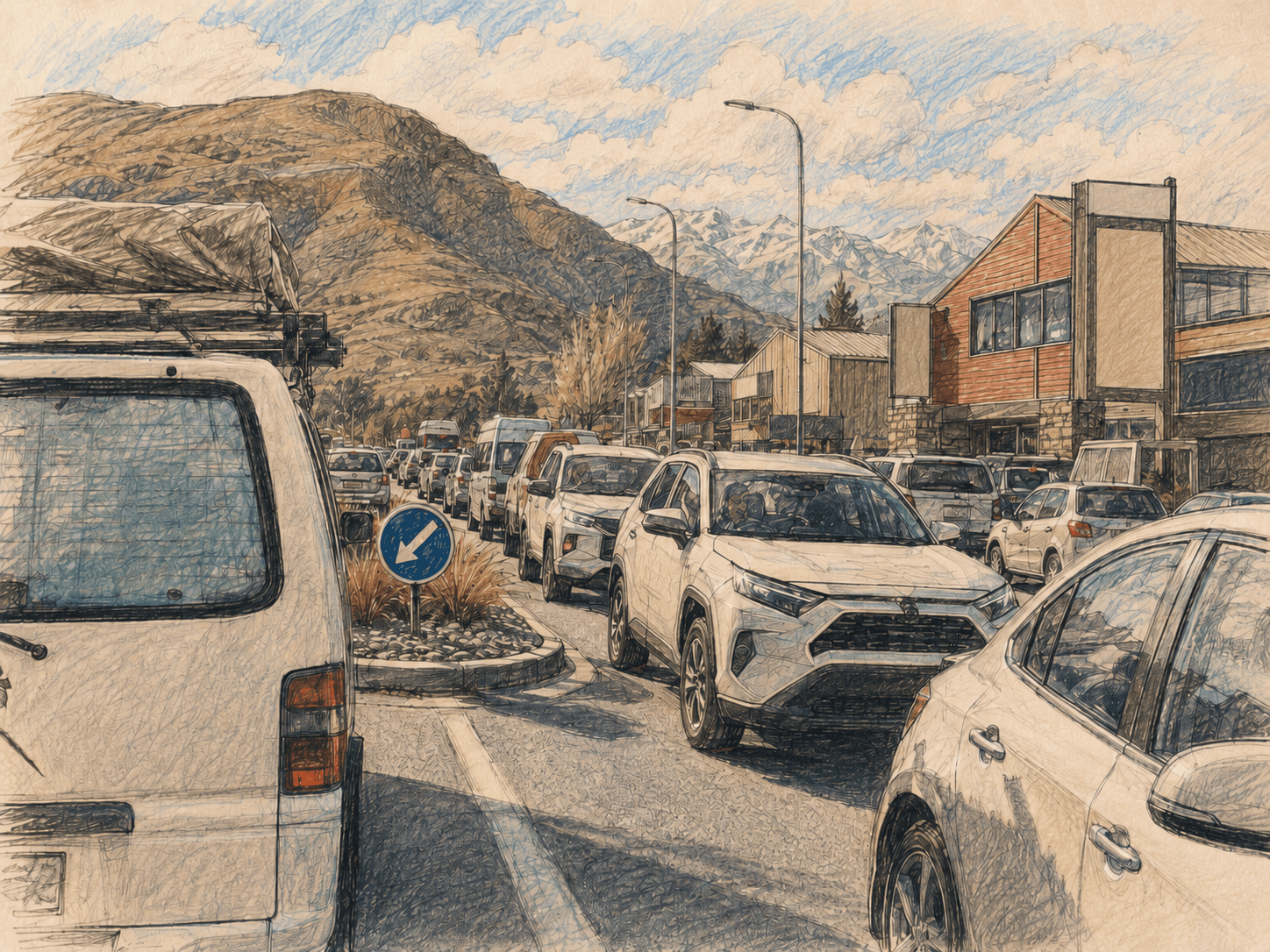
At around 4pm, it took me one hour and 44 minutes to get from Arrowtown to Queenstown Airport.
Normally, that's just part of everyday life here. Arrowtown to Frankton. School. Airport. Supermarket. Work. Gym. Home.
That afternoon it became an expedition.
And I was certainly not the only one.
Queenstown was talking about it
A heavily discussed post in a local Facebook group captured some of the frustration.
One person reported moving only 43 metres in an hour on Glenda Drive.
Another said they had left Remarkables Park at 3pm and, three hours later, were still trying to get along Glenda Drive towards Pak'nSave.
Someone who said they had driven extensively around New Zealand described Friday's traffic as unlike anything they had experienced in another New Zealand city.
Another person asked a very practical question:
Shouldn't there have been more traffic management on the ground?
The comments quickly became the usual Queenstown argument.
Some blamed overdevelopment and said infrastructure should have come first.
Others pushed back. People keep moving here. Queenstown needs housing. Development supports construction jobs and businesses. Simply stopping everything doesn't magically solve the problem either.
Another commenter argued that the bigger issue is central-government investment and that Queenstown needs serious spending on roads and public transport.
This wasn't a poll. It doesn't tell us what every Queenstowner thinks.
But it shows something useful.
People were not only angry about Friday.
They were asking what Friday tells us about the place we are building.
Then the Community Desk received something
After the gridlock, a community member contacted Queenstowning.
They didn't want to be featured or identified. They simply sent us a preliminary document they had developed and invited us to check it, question it and take the idea further.
That's exactly what we want the Queenstowning Community Desk to be for.
The document reconstructs Friday's disruption, distinguishes between reporting road conditions and predicting their wider consequences, and proposes testing whether existing traffic, weather and public-transport data could forecast congestion before the network becomes saturated.
Its central question is simple:
Could Queenstown tell us what is likely to happen next, rather than only what is happening now?
So the Community Desk brought the question to me as Queenstowning's editor.
And I think it is worth investigating.
We were informed. But was that enough?
This is important.
QLDC and NZTA were communicating.
Road restrictions were being published. Highway conditions were being updated. Crews were dealing with flooding, debris, slips and damaged roads.
So I don't think the fair conclusion is:
Nobody told us anything.
The more interesting distinction in the Community Desk proposal is between information and prediction.
“Gorge Road is down to one lane” is information.
“One Mile has reduced capacity, Gorge Road is restricted, another route is closed and, based on current volumes, Frankton is likely to lock up within the next hour” is something different.
That's prediction.
And Friday demonstrated why that difference might matter.
One commenter in the Facebook discussion described what happened as a network effect: several routes lost capacity, more traffic was pushed through Frankton, queues formed around already constrained intersections, and congestion then spread in different directions.
That description is remarkably close to the problem the Community Desk document wants to model.
So yes, I want to know whether Queenstown could see that coming.
But I have another question too.
What about people on the road?
Maybe not every solution needs to wait for a new model, another business case or another ten-year transport strategy.
When Frankton reaches the point we saw on Friday, could trained traffic-management staff be sent into critical intersections to help vehicles move?
Could somebody actively manage competing flows around the airport, Glenda Drive and the major junctions?
Could emergency traffic plans be triggered once the network reaches a certain level of congestion?
I don't know whether that would have improved Friday.
In fact, badly coordinated manual intervention can potentially move a queue from one place to another.
That's why I am putting it here as a question, not pretending it is the answer.
But it's a question worth asking.
Because there is a gap between the infrastructure Queenstown may eventually build and the town we have to move around this morning.
People need some solutions now too.
Maybe we're still calling a city a town
This is where my own view starts entering the conversation.
I think part of the problem may be conceptual.
We still talk about Queenstown Lakes as though we are managing a collection of small towns.
And technically, of course, they are different communities.
But try living your normal Tuesday without moving between them.
People live in Lake Hayes and work in Queenstown.
They live in Arrowtown and take their children somewhere else for school.
They go to Frankton for the supermarket.
To Five Mile for shopping.
To the airport.
To the gym.
To dinner.
Then home again.
Those movements are not exceptional.
They are daily life.
Maybe we need to stop thinking about these places only as separate settlements connected by roads.
Functionally, they are increasingly part of the same urban system.
Queenstown? Some days it feels more like Queenscity.
And if that's the reality, perhaps the infrastructure needs to be planned at that scale too.
Growth cannot run indefinitely ahead of infrastructure
This was probably the deepest disagreement in the Facebook conversation.
Is development the problem?
One side says Queenstown has allowed too much development before roads and infrastructure were ready.
The other says developers are responding to something real: population growth, housing demand and an economy that needs workers. Stop development altogether and you create a different set of problems.
I think both arguments contain something important.
My own provisional view is not that Queenstown should simply shut the gates.
I came here too.
Plenty of us did.
And telling the next person they can't come because those of us already here got in first isn't much of a growth strategy.
But I do think the pace of development has to be much more closely connected to the infrastructure capable of supporting it.
If a new development means hundreds or thousands more daily movements through a transport network that is already failing at its most vulnerable points, it is fair to ask:
What comes first?
The houses?
Or the capacity required to connect the people who will live in them?
Queenstown cannot keep approving the future and then asking the present to somehow absorb it.
Eventually that becomes a quality-of-life issue.
And I think we're getting close to that line.
Prediction is useful. It isn't the infrastructure
This is also where I would put a limit around the original Community Desk idea.
A predictive traffic model could be useful.
Very useful, perhaps.
But an algorithm cannot create another road.
It cannot remove a slip.
It cannot magically create bus priority.
And it cannot solve decades of growth by telling us 45 minutes earlier that we're about to get stuck.
The submitted proposal itself acknowledges this. Predictive technology should complement infrastructure, not substitute for it.
Our initial research also found that Queenstown is not starting from zero.
QLDC and the Way to Go partners have already commissioned a new Queenstown Lakes District transport model, intended to improve transport planning and forecasting.
That discovery makes the story more interesting.
What exactly will it do?
Is it primarily about planning years into the future?
Can it help during an event happening right now?
What information did the agencies have on Friday?
What could they see?
What could they predict?
Those questions are now going to Part II.
And then there is public transport
I also want to be careful here because this is another part I need to research properly.
There are major transport ideas being discussed for Queenstown, including cable-based transport and improvements to public transport.
Some of those projects could be useful.
A cable connection could be brilliant for certain journeys and probably attractive for visitors too.
But I'm not yet convinced that one corridor solves the Queenstown transport problem.
Because the way locals move is messy.
School.
Work.
Pak'nSave.
Airport.
Gym.
Remarkables Park.
Arrowtown.
Lake Hayes.
Jacks Point.
Queenstown.
Home.
Sometimes with children.
Sometimes with groceries.
Sometimes at 6am.
Sometimes at 10pm.
That's why I suspect the bigger question is not simply whether Queenstown needs a bus or a cable or another road.
It's whether we actually have the beginnings of an integrated transport system.
Can I leave my car somewhere sensible and reliably continue by bus?
Can buses move when cars can't?
Do services connect the places people actually travel between?
Can walking, cycling, buses, roads and perhaps future aerial or water transport function as parts of one network rather than separate projects?
That's intermodality.
And from where I sit today, I am not yet seeing enough evidence of that bigger picture.
But that's an opinion I want to test against the actual plans.
So perhaps Friday gave us three problems, not one
The Community Desk started with one good question:
Could we predict the next gridlock before it happens?
After looking at Friday and listening to what locals were saying, I think the conversation is already bigger.
What can we do next time?
Better prediction. Better information. Perhaps better active traffic management when the network starts failing.
What can we do with the Queenstown we have now?
Better buses, resilience, coordination and a transport network that works as a network.
And then the difficult one:
What Queenstown are we actually building?
If this place now functions more like a small metropolitan area than a collection of isolated towns, our infrastructure, development decisions and funding arrangements eventually have to catch up with that reality.
Because the cost of getting this wrong isn't only measured in minutes sitting on Glenda Drive.
It's missed flights.
Late workers.
Children waiting to be collected.
Businesses losing productive hours.
People deciding not to go somewhere because getting home might take two hours.
And eventually it is something harder to put into a spreadsheet:
quality of life.
Friday was caused by exceptional weather.
The vulnerability it exposed was not.
This is Part I of a Queenstowning Community Desk conversation with the Queenstowning editor. For Part II, we will look at what transport modelling and real-time traffic-management capability already exists, what happened operationally on 28 August, the current infrastructure and public-transport plans for the wider Queenstown area, and whether the solutions being proposed match the way people actually live and move here.
ABOUT THE AUTHOR
Community / Editor
Ideas, questions, observations and information shared with Queenstowning by the community, independently reviewed and developed by our editorial team.
View profile →
Enjoyed this story?
Queenstowning is independently built. If you enjoy what we’re creating, you can help keep the stories coming by buying the team a coffee.
Buy the team a coffee ☕
Tag @Queenstowning or use #Queenstowning and show us your version of the Queenstown state of mind.