
By Cesar Carvajal
Founder & Editor
Cesar Carvajal
•

Drive through Arthurs Point towards Arrowtown and there is a moment when the road narrows, the traffic gives way, and everything has to pass across the Shotover River one direction at a time.
That is the Edith Cavell Bridge.
Completed in 1919, the reinforced-concrete arch bridge has carried traffic across the river for more than a century. It is also a Category 1 historic place, recognised by Heritage New Zealand for its architectural and historical significance.
But in 2026, the bridge is doing much more than preserving a piece of Queenstown’s history.
It carries local traffic, buses, people travelling towards Coronet Peak and drivers using the Arthurs Point route between Queenstown and Arrowtown. QLDC has identified the crossing as an important part of the wider Queenstown transport network.
And increasingly, the question is whether a single-lane bridge built more than 100 years ago can continue carrying that responsibility.
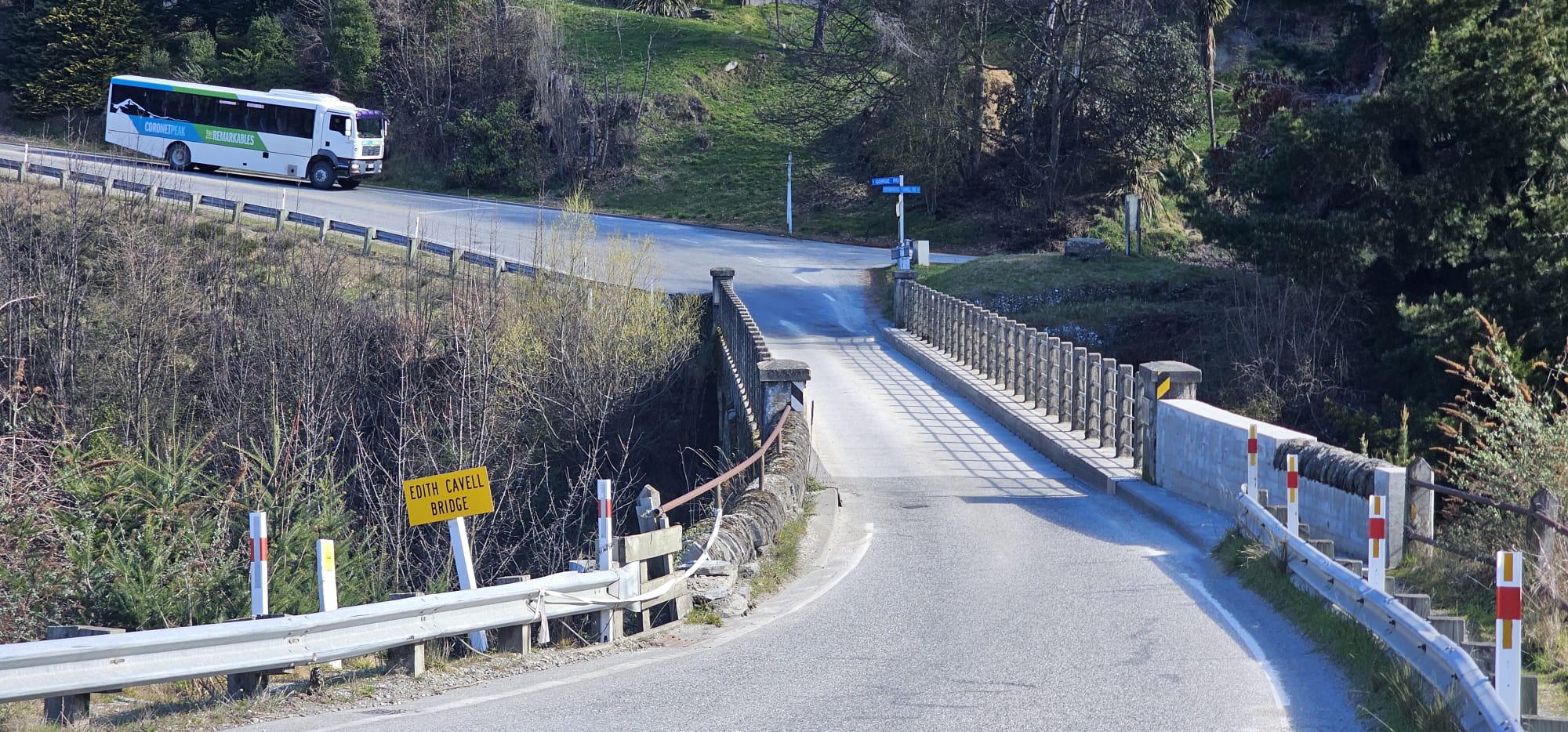
Edith Cavell Bridge was completed in 1919 and is listed as a Category 1 historic place. Photo: Queenstowning.
Why the bridge is back in the conversation
That question became particularly visible this month.
Recent earthquakes forced the Edith Cavell Bridge to close while engineers inspected it. It subsequently reopened, but the interruption affected bus services through Arthurs Point and again highlighted how dependent the area is on a single crossing.
The bridge has been closed twice in recent months for post-earthquake inspections. Otago Regional Council has said closures affect several public transport services and could require alternative routing if the bridge’s use changed for a longer period.
The earthquakes have not created the underlying issue.
They have simply brought attention back to something transport planners have been considering for years.
A 2021 business case described the bridge as reaching the end of its usable life, with increasing maintenance requirements and uncertainty about how the structure would perform in an earthquake. That assessment also identified congestion, the lack of safe walking and cycling facilities and the importance of the crossing to the wider transport network.
That does not mean the bridge has been declared unsafe for normal use today. Heritage New Zealand also explicitly notes that heritage listing information should not itself be interpreted as an assessment of structural or earthquake safety.
But it does explain why replacement planning has continued.
So what is actually proposed?
The endorsed 2021 Arthurs Point Crossing business case proposed a staged solution.
Its preferred option included a new two-lane road bridge approximately 100 metres downstream from Edith Cavell Bridge.
Once that road crossing was built, the historic bridge would no longer carry normal vehicle traffic and would instead be retained for walking and cycling.
The same business case also proposed a separate walking and cycling bridge approximately 400 metres downstream as an earlier stage of the project. That component was intended to improve active-transport connectivity before the larger road bridge was required.
That earlier active-transport crossing has not been built.
QLDC has since completed improvements along the Arthurs Point–Queenstown active-travel route, but the council acknowledged that those works did not include a new crossing of the Shotover River.
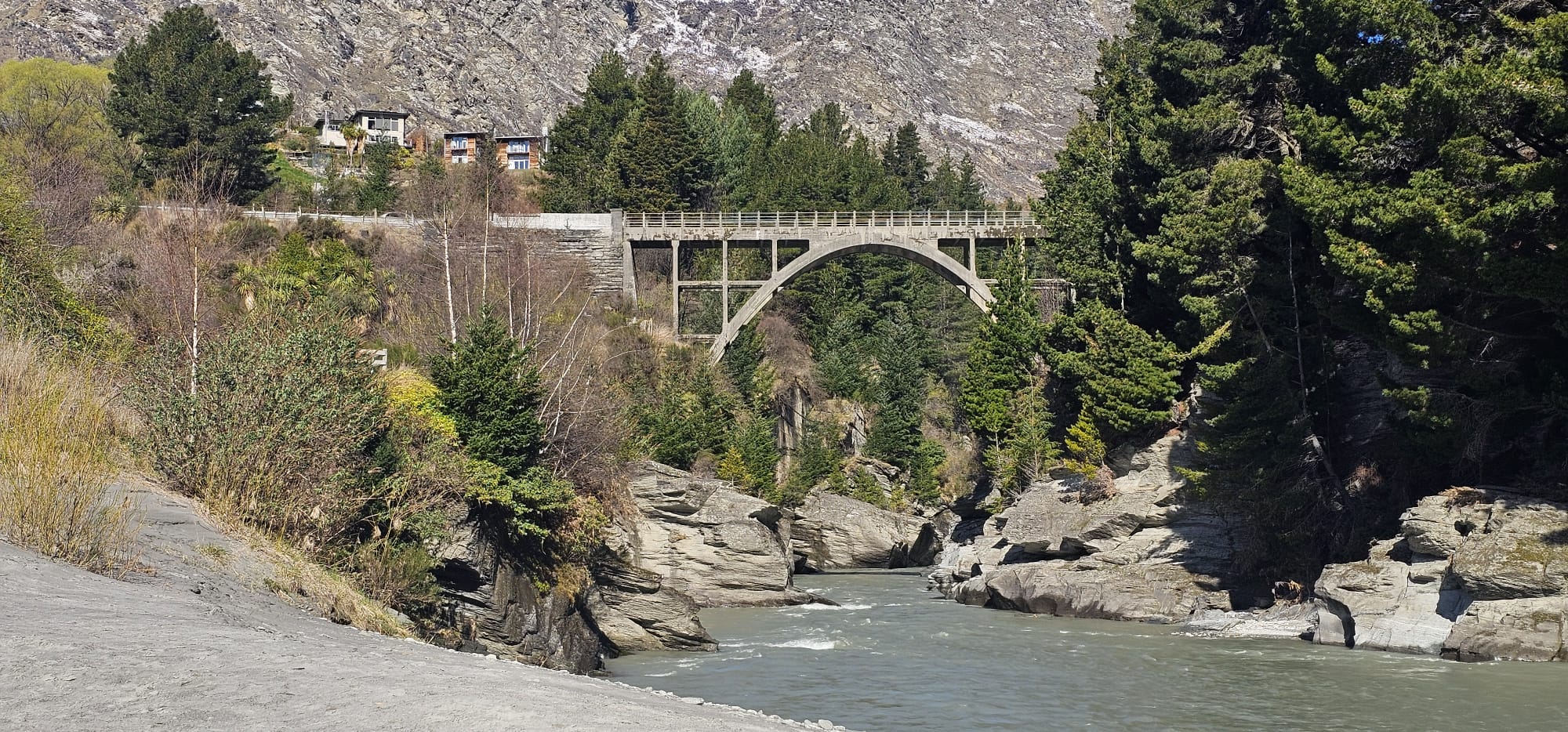
The 2021 business case proposed a new two-lane road bridge around 100 metres downstream from Edith Cavell Bridge. Photo: Queenstowning.
Importantly, the 2021 design should not necessarily be treated as the final design that will eventually appear beside Edith Cavell Bridge.
QLDC has been updating the Arthurs Point Crossing business case, and the council’s Assets & Infrastructure Committee received a dedicated project update on 1 September 2026.
That means the project is active again at planning level, but decisions about its final configuration, programme and funding remain part of the work still ahead.
Why not just keep using the existing bridge?
Capacity is only one part of the argument.
Because Edith Cavell Bridge is single lane, opposing traffic must take turns crossing it. QLDC has identified peak-time capacity and delays as issues at the crossing.
Walking and cycling are another issue.
There is no separate protected route across the existing bridge, meaning people walking or riding have to negotiate the same narrow crossing as vehicles. Providing a safer active-transport connection was one of the central objectives of the original crossing project.
Then there is resilience.
Queenstown does not have an abundance of alternative routes.
If the Arthurs Point crossing becomes unavailable, traffic that would otherwise use that road has to shift elsewhere in an already constrained network. The recent earthquake closures offered a small example of what that disruption can look like.
That becomes particularly important when Queenstown is simultaneously planning for more housing, more residents and continued visitor demand.
A bridge can therefore be both a local Arthurs Point issue and a wider Queenstown infrastructure issue.
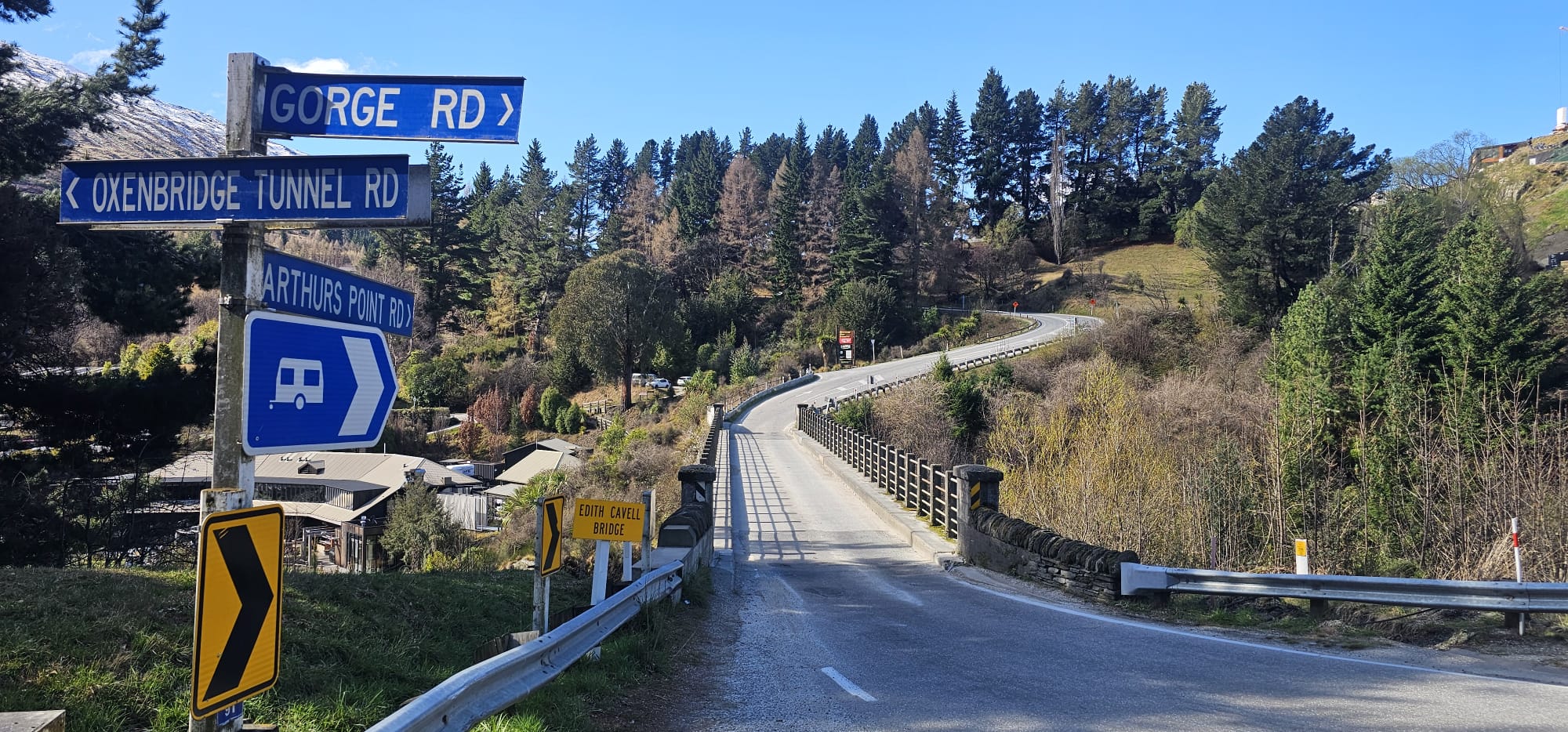
Edith Cavell Bridge one direction at a time. Photo: Queenstowning.
What would happen to Edith Cavell Bridge?
Under the endorsed business case, it would stay.
Rather than demolishing the historic structure, the plan has been to remove regular vehicle traffic after the new road bridge opens and retain Edith Cavell Bridge for pedestrians and cyclists.
That matters because the bridge is more than transport infrastructure.
Construction began in 1917 and finished in 1919. Heritage New Zealand describes it as an important early example of a reinforced-concrete arch bridge. It replaced earlier crossings that had served the Shotover since the gold-rush era.
Its name also has an unusual history.
The bridge became associated with Edith Cavell, the British nurse executed in Belgium during the First World War. Te Ara records that when authorities did not initially accept a suggestion to name the bridge after her, local miner Jack Clark painted her name on it anyway. The name remained.
So although people often talk about “replacing the Edith Cavell Bridge”, the project is more accurately about replacing its role as the main road crossing while preserving the bridge itself.
How much will the new crossing cost?
This is where the project becomes more complicated.
Current public reporting puts the latest estimate at around $80 million.
QLDC has already provided for the project within its long-term infrastructure planning, but the council is not expected to carry the entire cost itself.
NZ Transport Agency Waka Kotahi told 1News this month that, under the current proposed approach, its normal Financial Assistance Rate would mean funding 51% of eligible project costs, with QLDC responsible for the local share. NZTA also made clear that no final funding decision had yet been made.
That funding question is important.
The bridge has been identified for years. The engineering need is not new. But identifying a project and securing enough money to construct it are two different stages.
Previous council reporting has also recorded that the Arthurs Point Crossing was not funded through the 2024–27 National Land Transport Programme, which contributed to the project being put on hold before the latest business-case work restarted.
When could it actually be built?
The original business case placed the new road bridge after 2031, while QLDC’s project information has placed funding for the improved Arthurs Point crossing towards the end of its long-term planning horizon.
Recent reporting, however, shows growing interest in bringing the project forward.
After the earthquake closures, Arthurs Point community representatives called for a clearer timeline, while Queenstown Lakes mayor John Glover said the bridge was high on the council’s infrastructure priorities.
Whether those events ultimately change the construction programme will depend on the updated business case, funding decisions and the work required before construction can begin.
So for now, 2031 remains an indication rather than a construction date written in concrete.
A small bridge carrying a much bigger question
Standing beside Edith Cavell Bridge, it is easy to see this simply as a story about an old structure.
But it is also a useful way of understanding the infrastructure challenge facing Queenstown.
The district continues to grow. More homes are being planned. More people need to move between communities. Public transport needs reliable routes. Walking and cycling networks need connections. And the transport system also needs alternatives when something goes wrong.
At Arthurs Point, all of those questions eventually arrive at the same narrow bridge.
The plan for another crossing has existed for years.
The question Queenstown is now waiting to have answered is how quickly the planning, the funding and the construction can catch up with the need.
Sources & further reading
Yes, I would include this at the bottom. Keep it understated - not an academic bibliography.
Sources & further reading
QLDC - Arthurs Point Shotover River Crossing project overview.
QLDC - Arthurs Point Crossing Single Stage Business Case.
QLDC - Arthurs Point Crossing Project Update, 1 September 2026.
Heritage New Zealand — Edith Cavell Bridge, Historic Place Category 1.
NZTA - Queenstown Lakes District Council normal funding assistance rate.
1News - Fresh calls for century-old Queenstown bridge to be replaced, 14 September 2026.
Te Ara - Edith Cavell Bridge history.
ABOUT THE AUTHOR
Founder & Editor
Editor and founder of Queenstowning, covering local affairs, infrastructure, community and life across Queenstown and the Whakatipu.
View profile →
Enjoyed this story?
Queenstowning is independently built. If you enjoy what we’re creating, you can help keep the stories coming by buying the team a coffee.
Buy the team a coffee ☕
Tag @Queenstowning or use #Queenstowning and show us your version of the Queenstown state of mind.