Local Life

By Cesar Carvajal
Founder & Editor
Cesar Carvajal
•

Queenstown Is Growing. Is the Infrastructure Keeping Up?
Traffic has become one of Queenstown’s most familiar conversations.
Frankton backs up. State Highway 6 slows. A crash or road closure can ripple across the basin. New subdivisions continue to appear, visitor numbers remain high, and getting from one side of town to another can sometimes take considerably longer than the distance would suggest.
But behind the traffic cones and daily frustration is another question:
What is Queenstown actually building to deal with it?
Today provides a useful moment to ask.
Later today, Queenstown Lakes District Council’s Assets & Infrastructure Committee is being briefed on the future of the Arthurs Point crossing - including a proposal that could eventually replace the one-lane Edith Cavell Bridge with a new two-lane road bridge.
It is one project among several that could reshape how Queenstown moves over the next decade.
So Queenstowning went looking at what is already under construction, what is planned, and what remains largely an idea.
Frankton is already being rebuilt
The most visible transport investment is happening around Frankton.
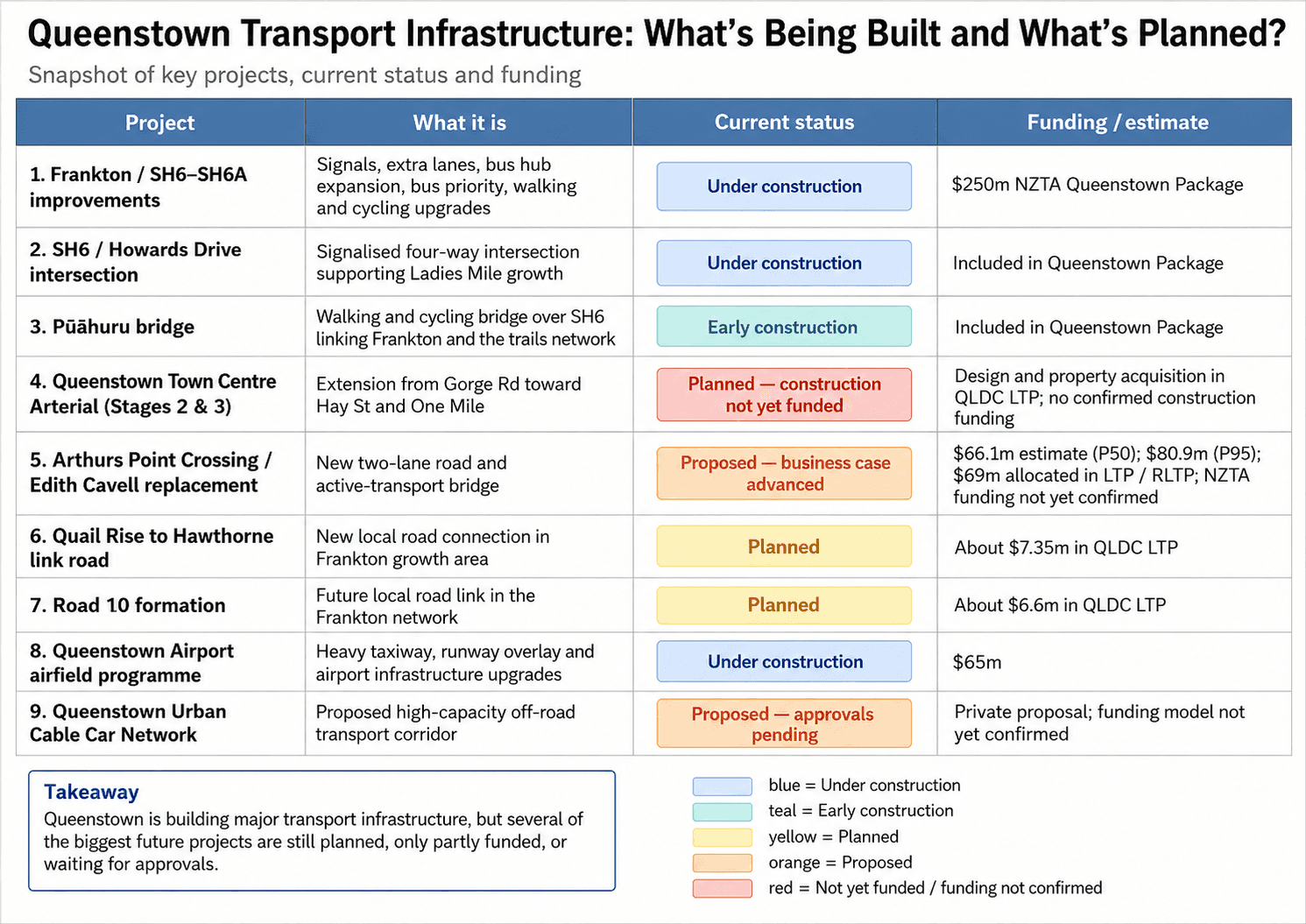
NZ Transport Agency is rebuilding the SH6/SH6A transport system around the existing BP roundabout. The roundabout is to be replaced by traffic signals, additional capacity is being created at nearby intersections, the Frankton Bus Hub is being expanded, and new bus, walking and cycling infrastructure is being incorporated into the corridor.
Work is also underway at the intersection of SH6 and Howards Drive, where the existing junction is being rebuilt as a signalised four-way intersection with pedestrian and cycling crossings and provision for future growth along Ladies Mile.
Nearby, Pūāhuru will provide a new separated walking and cycling bridge over SH6, connecting communities around the Shotover River with Frankton and the wider trail network.
These are substantial changes.
But they are largely improvements to the transport corridors Queenstown already has.
Then there is the road Queenstown has only half built
Closer to town, Stage 1 of the Queenstown Town Centre Arterial is complete.
The longer plan, however, has always involved three stages: Stage 2 from Gorge Road to Hay Street and Stage 3 continuing from Hay Street towards One Mile.
Those next stages are not currently funded for construction.
QLDC’s Long Term Plan provides funding for early design and land acquisition from 2029–30, but there is currently no funded construction programme for completing the road.
That distinction - between infrastructure that is planned and infrastructure that is actually funded - becomes important when looking at Queenstown’s transport future.
A new bridge at Arthurs Point
Then there is Edith Cavell Bridge.
Opened in 1919, the single-lane crossing is more than a local bottleneck. The Arthurs Point route is also the official alternative when SH6 and SH6A between Frankton and Queenstown are closed.
QLDC’s latest business case says a 2025 assessment identified structural concerns and concluded parts of the bridge may remain in acceptable condition for only another 10 to 20 years.
The preferred solution is now a new two-lane road and active-transport bridge, approximately 100 metres downstream from Edith Cavell Bridge.
The current expected estimate is $66.1 million, rising to $80.9 million when higher risk allowances are included. The business case says $69 million has been allocated through QLDC's Long Term Plan and the Regional Land Transport Plan, with the project currently envisaged for completion around 2031–32.
But there is another important qualification: the project is not yet included in the National Land Transport Programme, meaning the NZTA funding pathway is still being worked through.
Later today, Queenstown Lakes District Council’s Assets & Infrastructure Committee will discuss the proposed crossing and the updated business case behind it - including where the project now sits on funding, timing and the pathway towards construction.
Queenstown Airport is expanding too
Transport infrastructure does not stop at the roads.
Queenstown Airport has begun what it describes as its biggest-ever airfield investment: a $65 million programme including a new heavy aircraft taxiway and a complete overlay of the main runway.
Concept designs are also being developed for a major expansion and redevelopment of the terminal, alongside changes to baggage handling, security, airport access, parking and public and active transport connections.
In other words, one of Queenstown's main gateways is also preparing for its next stage of growth.
And then there is the cable car
Perhaps the most ambitious transport proposal is not a road at all.
The privately proposed Queenstown Urban Cable Car Network would create two high-capacity lines: one connecting Queenstown Airport with the town centre, and another extending from Frankton towards Ladies Mile through Five Mile and Lower Shotover.
Its proponents argue that Queenstown needs a transport system that can move large numbers of people without sitting in the same congestion as cars and buses. The proposal remains subject to approvals and funding arrangements, with the project team currently targeting construction from late 2027.
Whether it ultimately gets built is another question.
But its existence says something about the scale of the transport problem Queenstown believes it may have to solve.
Because Queenstown itself isn't finished growing
This is where the infrastructure question becomes more interesting.
It is not enough to compare these projects with the Queenstown we know today.
They need to be compared with the Queenstown being planned for tomorrow.
Council planning documents describe Te Pūtahi Ladies Mile as a future urban neighbourhood capable of adding roughly 1,700 to 2,400 dwellings.
South of the Kawarau River, around Hanley’s Farm, Jack’s Point and Homestead Bay, the Te Tapuae Southern Corridor could eventually accommodate up to another 7,000 homes once appropriately zoned.
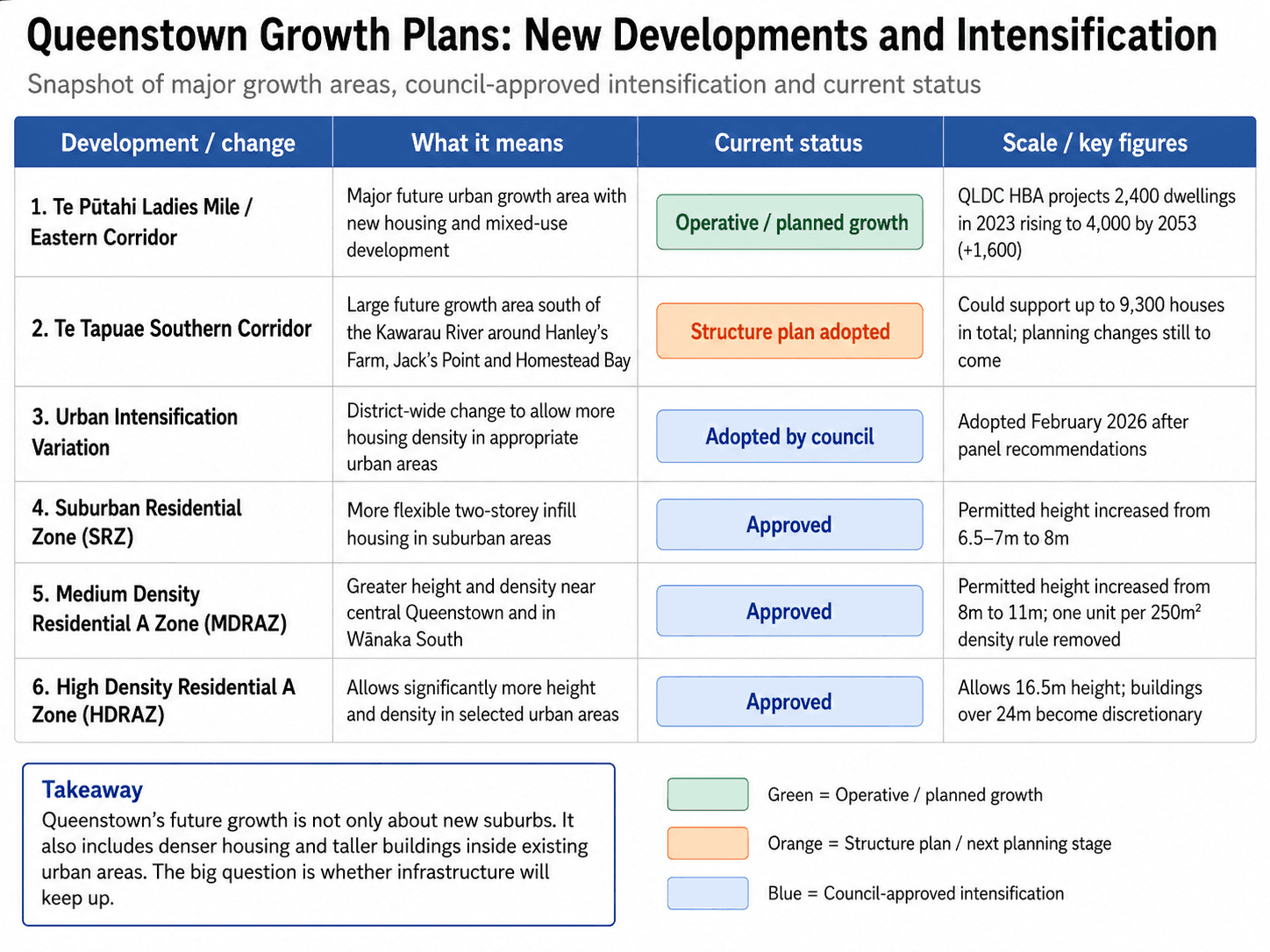
Queenstown is also moving towards greater residential density around existing urban areas. In February, Council adopted changes enabling greater height and density around parts of central Queenstown and other urban areas.
Those developments deserve their own investigation.
Where exactly are Queenstown's next neighbourhoods going? How many people could eventually live in them? What schools, water systems, wastewater systems, roads and public transport will they require?
That will be a question for another Queenstowning story.
But for now, it leaves us with a simpler one.
Is it enough?
Queenstown is not doing nothing.
Hundreds of millions of dollars of transport and aviation infrastructure are either being built, designed or considered.
Frankton is being reconstructed. A new Arthurs Point bridge is advancing through planning. Parts of the active-transport network are expanding. The airport is undergoing major investment. An arterial remains unfinished. And a completely different form of mass transport is being proposed above the roads.
But Queenstown is also continuing to expand.
Thousands of additional homes are contemplated around the Whakatipu Basin, the airport is preparing for future demand, and many of the journeys created by that growth will continue to converge on a relatively small number of roads, bridges and intersections.
So perhaps the question is no longer simply whether Queenstown is building infrastructure.
The question is whether what we are planning today will be enough for the Queenstown we are building tomorrow.
What do you think?
ABOUT THE AUTHOR
Founder & Editor
Cesar Carvajal is a Colombian-born writer, former lawyer and chef who calls Queenstown home. As founder and editor of Queenstowning, he follows the things shaping life around town - development, traffic, infrastructure, community conversations, food, arts, events and the everyday contradictions of living in this little corner of New Zealand. He is also the author of The Older Brother.
View profile →
Enjoyed this story?
Queenstowning is independently built. If you enjoy what we’re creating, you can help keep the stories coming by buying the team a coffee.
Buy the team a coffee ☕
Tag @Queenstowning or use #Queenstowning and show us your version of the Queenstown state of mind.