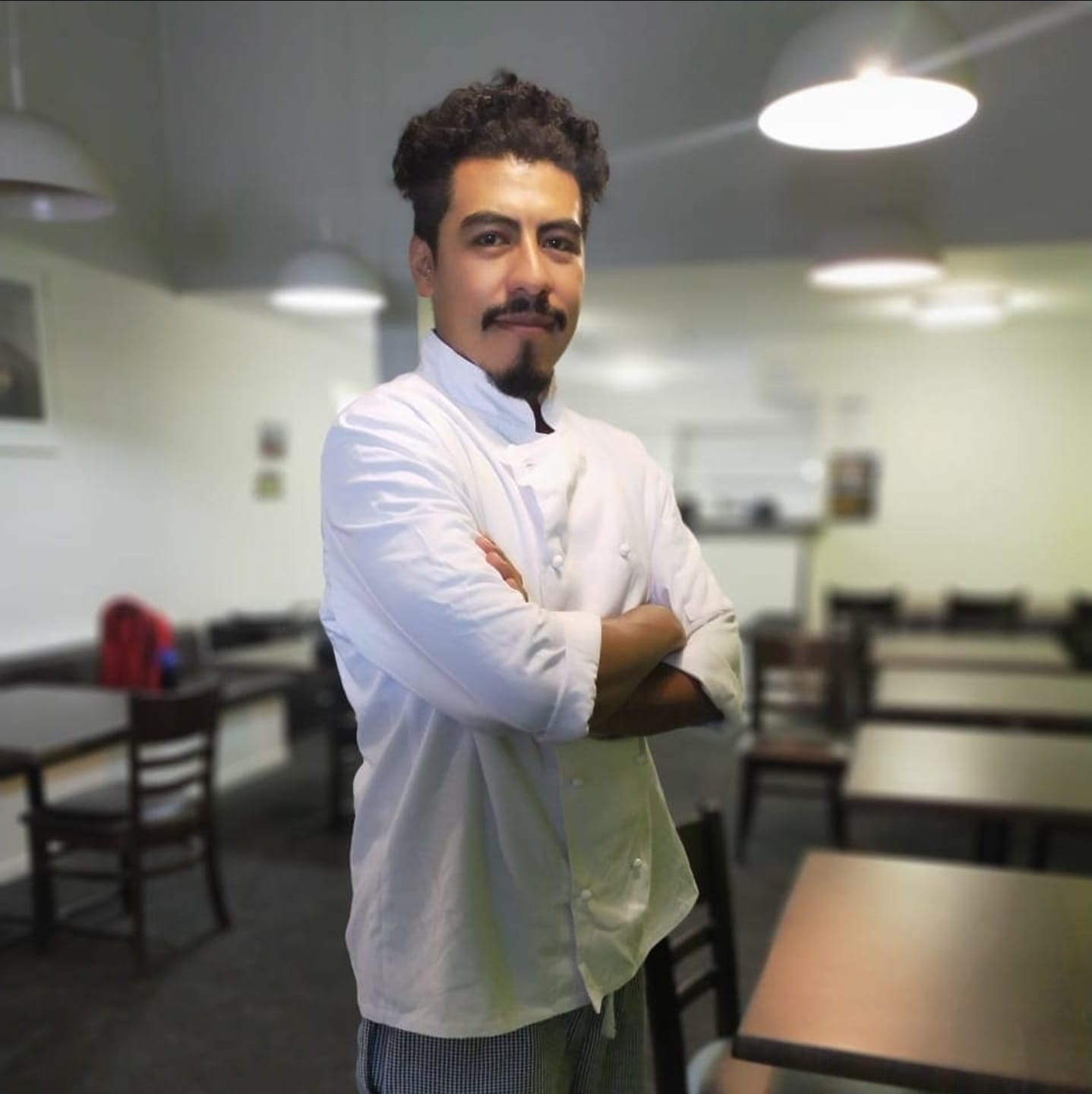
By Cesar Carvajal
Writer / Editor
Cesar Carvajal
•

There is a jaguar living in Glenorchy.
Its tongue is out, its colours are loud and, surrounded by the mountains of the South Island, it looks strangely at home. At first I thought somebody had adapted the image, perhaps mixing something Mexican with Māori influence to make it belong a little more to New Zealand. Gaby corrected me straight away. No. That was the jaguar from Guerrero, Mexico, exactly as it was meant to be.
I liked that answer. The jaguar hadn't needed to change to arrive here. It had simply travelled.
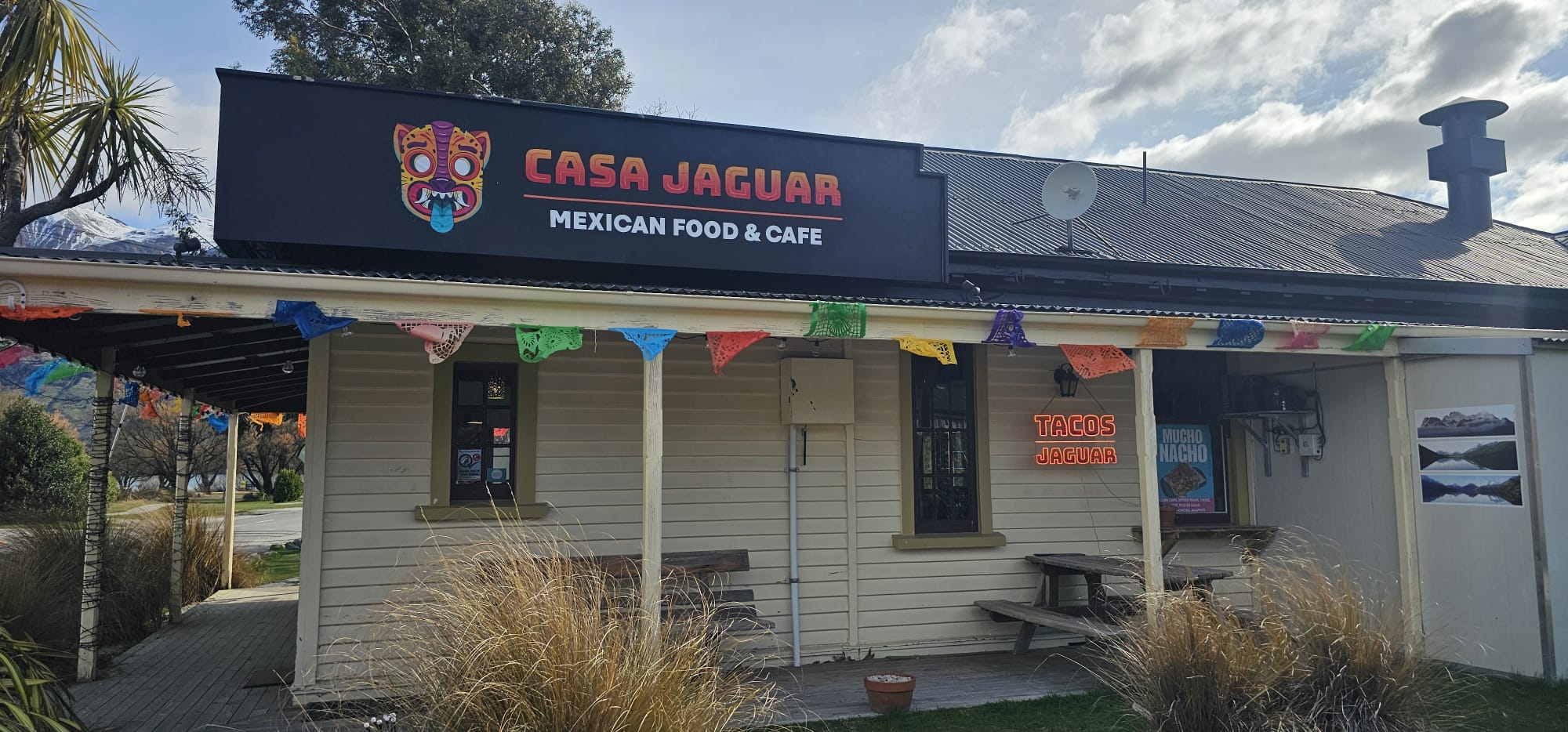
A few days earlier I had put something on Facebook asking where the food stories around Queenstown were hiding. Gab Ruiz and Gabriela “Gaby” de la Rosa came onto our radar. Their name was already familiar to me because I had seen Tacos Jaguar a couple of times around Industrial Place in Queenstown, and to be honest, I thought they were still there. Then, on Saturday morning, without much planning, Cassie suggested we drive to Glenorchy, go for a walk and find somewhere for lunch.
We arrived at Casa Jaguar without an appointment and with no idea whether Gab and Gaby would even have time for us. I know hospo; sometimes the last thing somebody needs in the middle of service is a person turning up with questions. We were happy just to eat.
And I knew there would be tacos for sure.
What I wasn't expecting was how quickly the conversation would move away from food - or perhaps deeper into it. Within a few minutes we were talking about migration, identity, dreams, community, and that strange moment when what you want, what you think and what you actually do begin to point in the same direction.
On the counter, beside a small sign saying ORDER TACOS HERE, there was a framed certificate from Mexico. Casa Jaguar had recently received the Sello M, a recognition for Mexican gastronomy abroad awarded through Mexico's Ministry of Foreign Affairs and the Mexican Academy of Gastronomy.
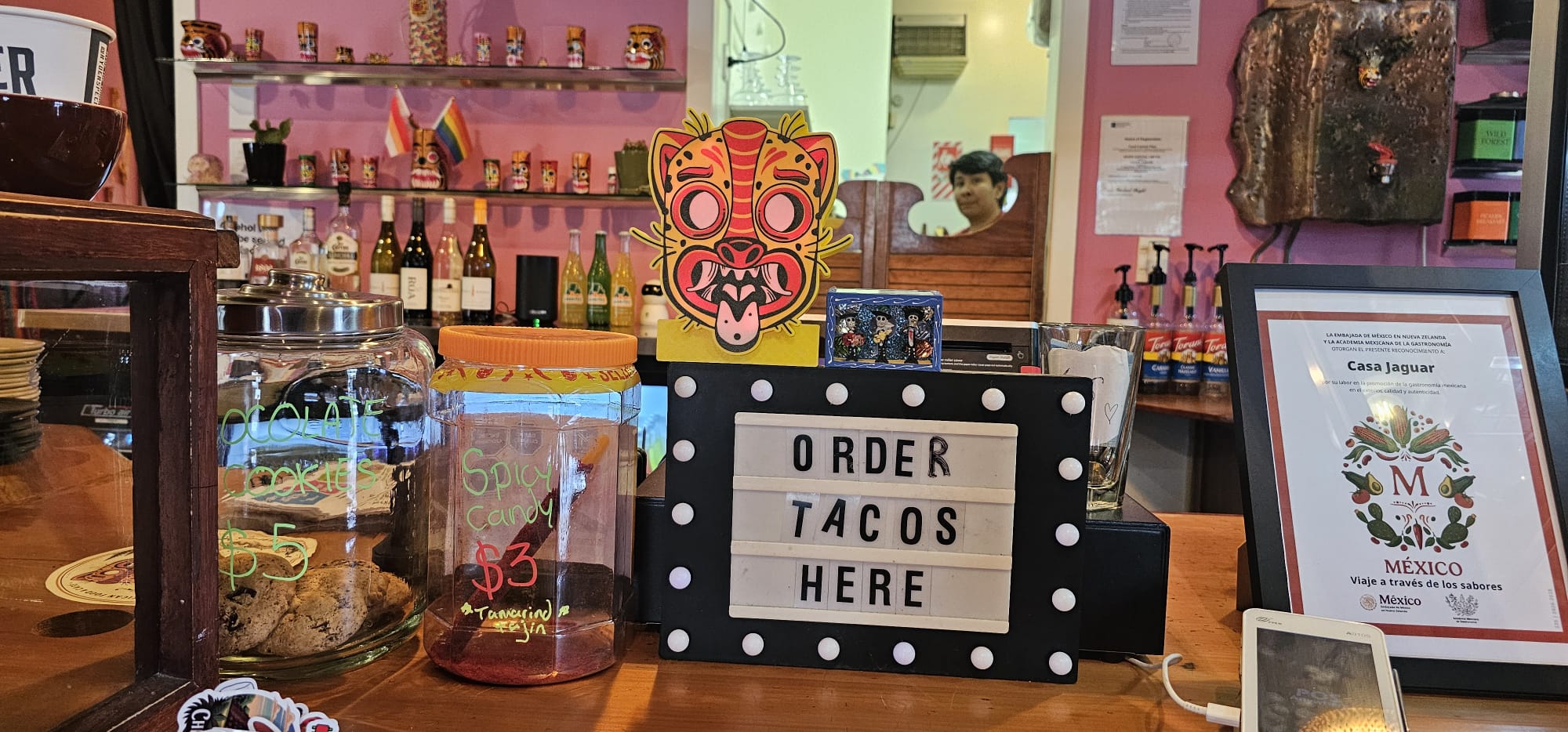
According to Gab and Gaby, theirs is the first and only restaurant in New Zealand's South Island to receive it. For a small restaurant sitting in Glenorchy, that is quite an achievement.
But after spending more time with them, the certificate began to feel less like the story itself and more like evidence of everything that had happened before somebody finally put it into a frame.
The jaguar travelled too
Casa Jaguar doesn't hide its identity. The room is full of bright walls, Mexican objects, little jaguars, handmade decorations, bottles of salsa, corn, humour and colour. There is a confidence to the place before anything reaches the table.
That was where my mistake with the jaguar happened. Its tongue reminded me somehow of Māori carving, and I wondered whether they had modified the image after arriving in New Zealand. Instead, Gaby explained that this was the original jaguar from Guerrero.
Somehow an animal carrying symbolism from one side of the Pacific had ended up inside an old Glenorchy house, surrounded by mountains and local stories, without needing to disguise where it came from.
That thought stayed with me because our conversation kept returning to dreams, although not the kind of dreams that live comfortably on motivational posters. Gab and Gaby were talking about the practical kind: wanting something, making a decision, working towards it, discovering that people respond to what you're doing, and then having to wake up the next morning and continue.
They told us how they started by selling tacos at a Latin festival and realised people loved them. One thing followed another. Their enthusiasm and skills met opportunity, and they jumped into the wave until eventually the jaguar became part of Glenorchy.
I felt some identification with that.
Migration has a strange way of doing this to people. You leave one place and arrive in another carrying the hope that perhaps you can bring something with you, even when you don't yet know exactly what that something will be. Sometimes it takes years before the pieces start connecting.
In their case, Mexican food crossed the Pacific and found a home inside a house already carrying its own Glenorchy history. I liked the coincidence of those layers - one culture arriving inside another without needing to erase either one.
And then I looked back at the table. A tortilla made that morning. The certificate from Mexico sitting on the counter. Two people talking about how things slowly became real.
Dreams look romantic once they're framed.
While they're happening, they usually look like work.
The tacos were getting cold
Eventually we had to stop philosophising because the tacos were sitting in front of me, and I wanted them while they were still hot.
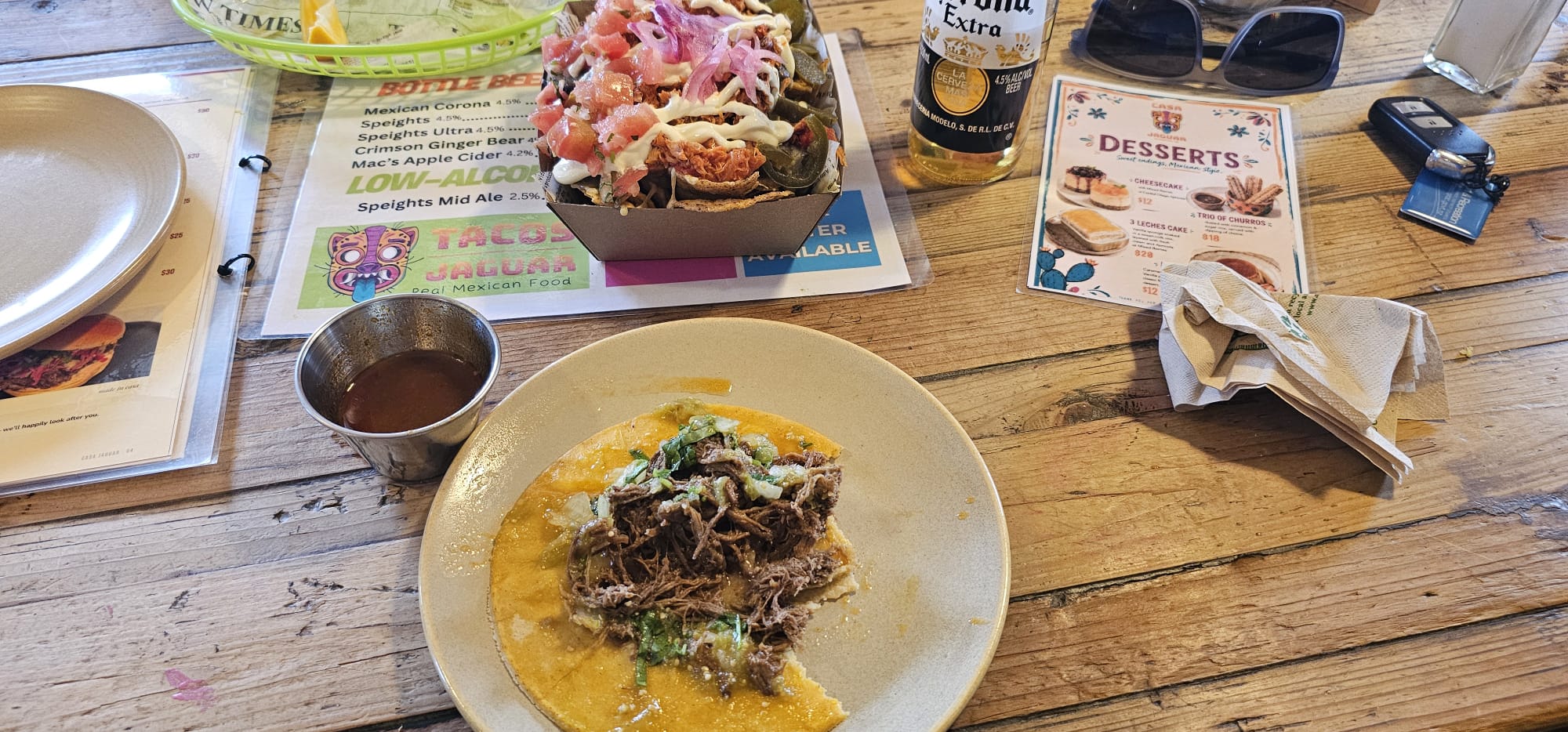
We started with the birria. The first thing that caught my attention was the tortilla, made in house, because for me that immediately changes a taco. Before you get to the beef, the salsa or anything sitting on top, you can taste and feel the corn itself. The tortilla stops being merely the thing that carries the food and becomes part of the dish.
Then came the beef: rich, soft, deeply cooked and beautiful. But the thing that surprised me most was the salsa verde. It was bright and acidic, fresh enough to cut through the richness of the meat without competing with it.
Then I noticed the tiny seeds from the green tomatillos.
That made me happy.
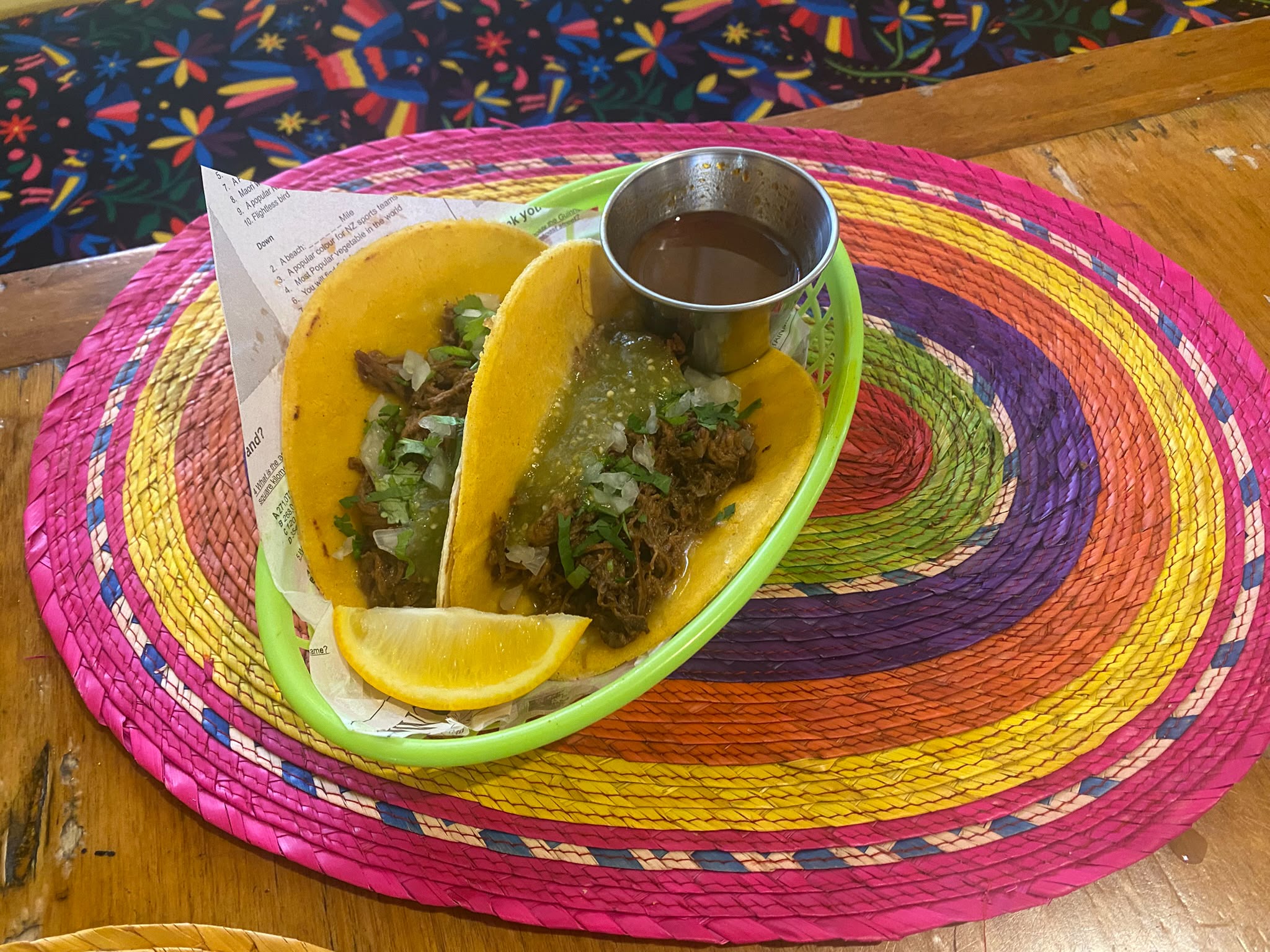
Maybe it is the former chef in me, but seeing those little seeds made the salsa feel even more alive. You could tell somebody had made it there rather than simply opened something and poured it into a bowl.
I kept going back to it and eventually told them what I was thinking.
“You're not shy with flavour.”
And they weren't.
At some point the taco started behaving exactly as a taco should. A little broth, lime and salsa verde began escaping from the tortilla and running onto my hands. I mentioned that this was how I liked to eat tacos, and Gaby told me they needed to be messy; that was part of the experience.
I had no argument with that.
By then the taco was disappearing, my Corona was disappearing too, and we moved on to the nachos.
The architecture of nachos
The chicken tinga nachos arrived colourful, generous and, most importantly, still crispy.
That might sound like a basic compliment until you've eaten enough nachos where everything underneath collapses into a wet construction site after thirty seconds. These held together. The corn chips had a proper crunch and enough corn flavour for me to mention it immediately.
There was richness in the toppings, freshness, acidity and spice, but the chicken tinga was the thing I kept going back to. Deep tomato flavour, good seasoning, tender chicken and enough intensity to make itself known among everything else on the plate.
Again, the same confidence I had noticed in the salsa verde was there.
And looking around the room, I realised Casa Jaguar isn't particularly shy about anything.
Not the colours, not the jaguars, not Mexico, not Guerrero, not who they are.
Maybe that's part of why the food works.
What does authentic actually mean?
The Sello M naturally brings up one of those dangerous food words: authenticity.
I find it complicated.
Food moves because people move. Ingredients change. Recipes adapt. The tomatoes you find in Glenorchy are not necessarily the tomatoes somebody's grandmother was buying in Guerrero. New Zealand beef is New Zealand beef. The climate is different, the suppliers are different and the kitchen is different.
So what exactly are we asking when we ask whether something is authentic?
For me, authenticity cannot mean freezing food in time. It cannot mean pretending you are physically sitting somewhere in Mexico when outside the window you have the mountains and landscape of the South Island.
What interests me much more is whether the knowledge behind the food survives the journey: the techniques, the flavours, the intention and, perhaps most importantly, the memory.
Gab and Gaby spoke about the food they grew up eating, the food cooked by their families and the flavours that became normal long before either of them was thinking about running a restaurant in New Zealand. Before opening Casa Jaguar, they went back to Mexico and reconnected with those memories - almost refreshing their understanding of how their tradition tasted.
I find that fascinating because there are flavours you can write down in a recipe, and then there are flavours you remember. The food your mum made, the smell coming from a family kitchen, the particular thing you ate so many times as a child that it became part of your reference point without you ever choosing it.
Perhaps authenticity isn't about refusing to change.
Perhaps it is about knowing what cannot be lost when you do.
Food becomes a language
Somewhere during lunch, our conversation stopped being about restaurants.
Or perhaps it never stopped being about restaurants at all.
Gab and Gaby talked about food as expression, identity, connection and community. It is an idea that keeps appearing while I explore food around Queenstown because, from the outside, a restaurant can look like a very simple transaction: someone is hungry, somebody cooks, somebody pays, somebody eats.
But behind many kitchens around this region there is somebody who arrived carrying invisible luggage. A recipe. A spice. A technique. A family habit. A grandmother's soup. A particular way of making bread. A memory of Sunday lunch. A flavour they haven't tasted for years.
Then one day they cook it for somebody who has never experienced it before.
That is when food becomes communication.
It says: this is where I come from. This is something my family knows. Try it.
And sometimes the person eating it understands something about the person who cooked it that neither of them could have explained as easily with words.
Casa Jaguar uses the phrase Mi casa es tu casa - my house is your house. Sitting there with Gab and Gaby, eating tacos, drinking a Corona and talking about Mexico, Glenorchy and the strange road between the two, it didn't feel much like a marketing slogan.
It felt fairly literal.
The certificate beside the tacos
Before leaving, I looked at the certificate again.
It carries the name of Mexico and recognises authenticity and quality, but what I liked most was where it was sitting: beside that little sign saying ORDER TACOS HERE.
Something institutional beside something completely ordinary.
Recognition matters, of course. But tomorrow somebody still has to make the tortillas. The salsa verde still needs to taste fresh. The birria still needs to cook. Somebody needs to open the doors, serve the customers and wash everything afterwards.
That might be the less glamorous part of making dreams come true.
It is probably the most important part too.
I originally went to Glenorchy because two Mexican women told us there was a food story there.
They were right.
The story wasn't simply that the birria was good, although it was. It wasn't simply that the tortillas were handmade, or that the chicken tinga made me continue eating long after I probably needed to.
The story was what all those things were carrying.
Two people travelled from Mexico to New Zealand with recipes, memories and skills. Somewhere along the way they chose a jaguar from Guerrero and started cooking.
Slowly the jaguar became part of Glenorchy. Locals began seeing them as part of the community, hungry hikers arrived after long walks looking for a proper meal, and travellers from different parts of the world found themselves in a little restaurant where a jaguar with its tongue sticking out was offering tacos that had somehow crossed the Pacific.
Then one day a certificate arrived from Mexico.
A formal way of saying:
Yes. We recognise what you're doing here.
Thousands of kilometres away from Guerrero, the jaguar found a home among the mountains.
And judging by the tacos, I think it's pretty happy in Glenorchy.
I will come for the Huevos Rancheros, as I told them that was the thing my father was cooking on Sunday morning when I was a kid.
ABOUT THE AUTHOR
Writer / Editor
Cesar Carvajal is a Colombian-born, Queenstown-based writer, editor and former chef. His food writing explores flavour, memory, migration and the people and stories behind the places we eat.
View profile →
Enjoyed this story?
Queenstowning is independently built. If you enjoy what we’re creating, you can help keep the stories coming by buying the team a coffee.
Buy the team a coffee ☕
Tag @Queenstowning or use #Queenstowning and show us your version of the Queenstown state of mind.