
By Cesar Carvajal
Founder & Editor
Cesar Carvajal
•

A few nights ago, I watched a Stuff report about the accommodation-levy debate and the possibility that Queenstown ratepayers could again be left carrying more of the cost of a town visited by millions.
It made me ask a simple question in the Queenstown Community Facebook group: who should pay for Queenstown?
I wasn’t campaigning for a bed tax, and I wasn’t trying to blame tourists. I wanted to open the door and listen.
I live here, work here and use these roads like everyone else. I’m also Colombian. I wasn’t born in Queenstown, but this is home now. Maybe that makes me especially interested in the relationship between the people who arrive here and the place that receives us.
Tourism gives Queenstown jobs, businesses, restaurants, opportunities and an international energy that a town this size would never have on its own. But visitors also use roads, water, wastewater systems, rubbish services, public toilets, parks and transport.
Someone pays for all of that.
So I asked the group. And Queenstown had plenty to say.
Visitors should contribute - but why only beds?
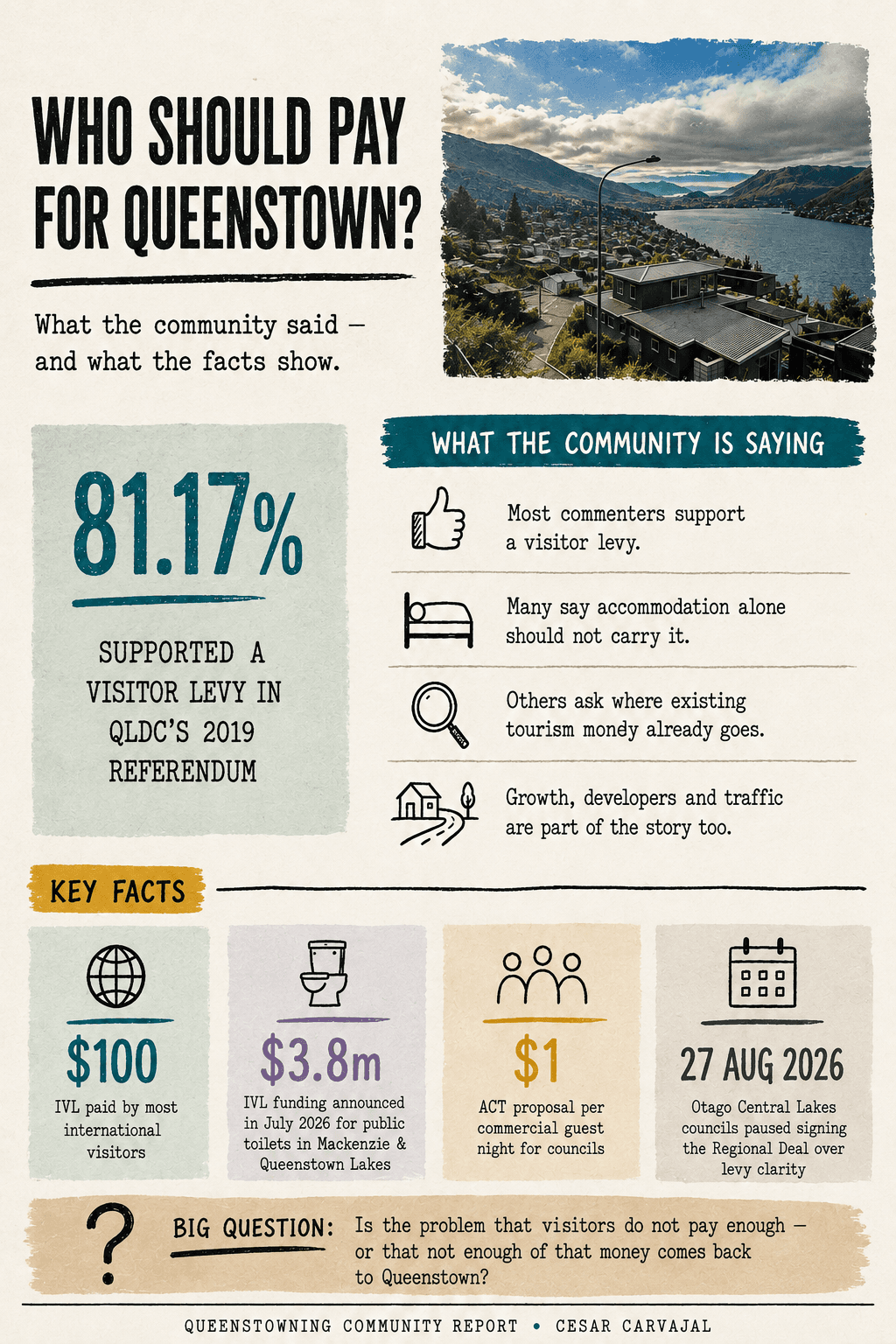
The strongest recurring view was that visitors should contribute more directly to local infrastructure. Many commenters had paid visitor levies overseas and saw the idea as normal rather than radical.
But support for a visitor contribution did not always mean support for a bed tax. Several people asked why accommodation should carry the burden when visitors also hire cars, book activities, eat out and use many other tourism services.
That produced one of the clearest themes in the thread: if Queenstown creates a visitor charge, people want it to feel fair across the tourism economy - not like one industry has been picked to collect the bill.
Then came the bigger question: where does the money already go?
This was where the discussion became more interesting.
Tourists already contribute through GST, business activity and, for most eligible international visitors, the $100 International Visitor Conservation and Tourism Levy (IVL). Tourism businesses and commercial properties also contribute through taxes and rates.
So some commenters asked a different question: is Queenstown’s problem really that tourism pays too little, or that not enough of the money generated by tourism finds its way back to the places carrying the infrastructure pressure?
It would be wrong to say none of it comes back. In July, the Government announced $3.8 million of IVL funding for public toilet infrastructure in the Mackenzie and Queenstown Lakes districts.
But the underlying question remains useful: how much is generated here, how much returns here, and is the balance right for a district with Queenstown’s visitor numbers?
Growth is not only tourism
Another commenter shifted the conversation by asking about property developers.
Queenstown’s infrastructure pressure also comes from population growth, new subdivisions, more commuters and more demand on roads and pipes. Developers are not contributing nothing: QLDC already charges Development Contributions when new development creates additional demand on local infrastructure.
The better question is whether the current mix of contributions from development, tourism, rates and central government matches the pressure each part of the system creates.
Traffic came into this discussion too. Some commenters argued that local commuting and growth deserve more attention alongside tourism. Specific traffic statistics were quoted in the Facebook thread, but I have left them out here because I could not verify them well enough for this report.
Queenstown has voted on this before
In 2019, QLDC held a non-binding referendum on a visitor levy on short-term accommodation. The final result was clear: 81.17% voted in support - 8,032 votes in favour and 1,863 against.
That does not tell us exactly what Queenstown thinks in 2026. A lot has changed since then. But it does remind us that this argument is not new.
And the politics are moving right now
On 23 August, National ruled out an accommodation levy as part of its “no new taxes” election pledge, saying it could not find a model that would avoid increasing costs for New Zealanders booking accommodation too.
Four days later, Queenstown Lakes, Central Otago and Otago Regional councils paused signing the Regional Deal while asking central government for clarity over the changed accommodation-levy commitment.
There is also another model on the table. ACT has proposed a Local Tourism Dividend that would give councils $1 for every commercial guest night, funded from GST and visitor levies already collected rather than from a new charge on accommodation.
Whatever you think of those policies, they reinforce something the Facebook thread made obvious: a bed tax is not the only possible answer.
So what did the community actually tell us?
This Facebook discussion was not a poll, and I do not want to pretend it represents every Queenstowner. People choose whether to comment, and strong opinions are more likely to show up.
But a few questions came through again and again:
· Should visitors contribute more directly?
· If they do, why should accommodation carry most of it?
· How much tourism money is already collected, and how much comes back to Queenstown?
· Are developers and population growth carrying their fair share of infrastructure costs?
· If new money is collected, how do we make sure people can see where it goes?
That last point matters. There was support for raising more money, but there was also mistrust about how it would be spent. For some people, the funding mechanism and the accountability around it are inseparable.
Perhaps I asked the wrong question
I started with: who should pay for Queenstown?
After reading the discussion, I think a better question is: how do we fairly share the cost of a place whose success benefits visitors, businesses, property owners, workers, developers, central government and the people who live here?
Maybe the answer is not finding one group to send the bill to. Maybe it starts with putting the numbers on the table: who already pays, who creates the pressure, who benefits, where the money goes and what the actual gap is.
That is less satisfying than shouting “bed tax” or “no new taxes”. But Queenstown is complicated.
And perhaps that is exactly why the conversation is worth having.
So, Queenstown: now that we have asked who should pay, should the next question be where the money already goes?
ABOUT THE AUTHOR
Founder & Editor
Colombian-born, Queenstown-based writer and founder of Queenstowning. Cesar writes about community, migration, reinvention and life in one of New Zealand’s most unusual little towns.
View profile →
Enjoyed this story?
Queenstowning is independently built. If you enjoy what we’re creating, you can help keep the stories coming by buying the team a coffee.
Buy the team a coffee ☕
Tag @Queenstowning or use #Queenstowning and show us your version of the Queenstown state of mind.