Community Report / Story

By Cesar Carvajal
Founder & Editor
Cesar Carvajal
•

Who Should Pay for Queenstown? Part II — The Cost of Success
In the first part of this story, I asked a fairly simple question:
Who should pay for Queenstown?
It began with the accommodation-levy debate, but the Facebook conversation didn't stay there for very long.
People talked about visitors. Ratepayers. Businesses. Developers. GST. Rental cars. Infrastructure. Traffic. Council. Central government.
And then one question kept appearing in different forms:
Where does the money already go?
So instead of moving on, I went back through the conversation properly.
I counted it. Read it again. Sorted the arguments. Looked at where people agreed, where they didn't, and what questions were left sitting on the table.
And then, a few days later, I walked into a room at The Rees Hotel for a Catalyst discussion about the future of tourism.
Funny enough, many of the same questions were waiting there too.
Maybe this story was never only about a bed tax.
Maybe it is about something bigger.
The cost of Queenstown's success.
We went back to read the room
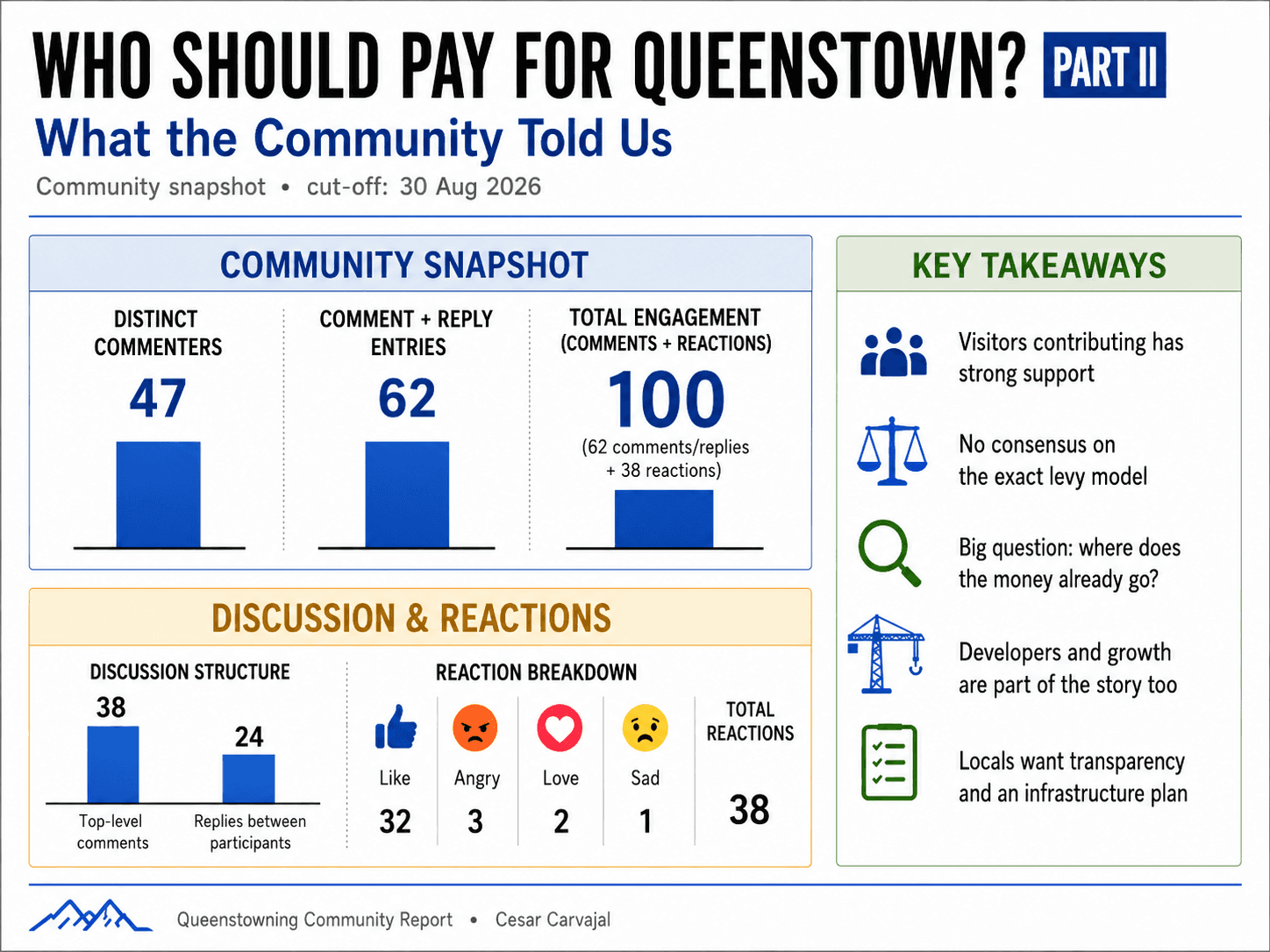
By our Sunday 30 August cut-off, the Facebook discussion had produced:
47 distinct named commenters
38 top-level comments
24 replies between participants
62 comment and reply entries
38 Facebook reactions
That gives us 100 engagement actions around the discussion. 62 comments or replies plus 38 reactions.
That does not mean 100 different people participated. Reactions and commenters may overlap.
The reaction breakdown was:
32 Like
3 Angry
2 Love
1 Sad
More interesting to me was what happened inside the comments.
Twenty-four of the 62 comment entries were people replying to other people.
So this wasn't simply a collection of answers to my original question.
Locals were debating each other.
First thing: this wasn't a poll
Before going any further, an important qualification.
This was a Facebook discussion.
It wasn't a representative survey of Queenstown. Nobody should take 47 commenters and turn them into “what Queenstown thinks”.
People who comment in community groups are self-selecting. Some views will be over-represented. Plenty of people read and never comment at all.
But that doesn't make the conversation useless.
It gives us something different.
It shows the arguments people are making, the experiences they're bringing into the discussion and, perhaps most importantly, the questions they think deserve an answer.
And there were some pretty clear patterns.
Visitors contributing has support. The mechanism doesn't.
The strongest signal was straightforward.
A considerable number of commenters thought visitors should contribute directly towards the infrastructure and services required to support a tourism destination like Queenstown.
But agreement started falling apart as soon as we asked:
How?
Some supported an accommodation levy.
Others asked why hotels and accommodation providers should carry the burden when visitors also use rental cars, attractions, roads, public toilets, rubbish facilities and other services.
Suggestions included:
an accommodation levy;
rental-car charges;
a wider tourism levy;
a fixed visitor fee;
airport or arrival charges;
and finding a better way of returning revenue already generated by tourism to the communities hosting it.
And there was also genuine opposition.
Some people argued tourists already pay plenty through GST, the International Visitor Conservation and Tourism Levy, accommodation, food, activities and other spending.
Their question was basically:
How many times do we want to charge the same visitor?
Fair question.
Then the question changed
As the discussion continued, the argument became much more interesting.
Instead of:
How do we collect more money?
people began asking:
How much money is already being generated?
And:
How much of it actually comes back to Queenstown?
Tourism generates GST.
International visitors can pay the IVL.
Businesses pay taxes and commercial rates.
Residents pay rates.
Developers make development contributions.
Central government funds some infrastructure.
Council funds other infrastructure.
Different institutions collect different pots of money and make different decisions about what gets funded.
Which means “where does the money go?” is not one question.
It's a whole system.
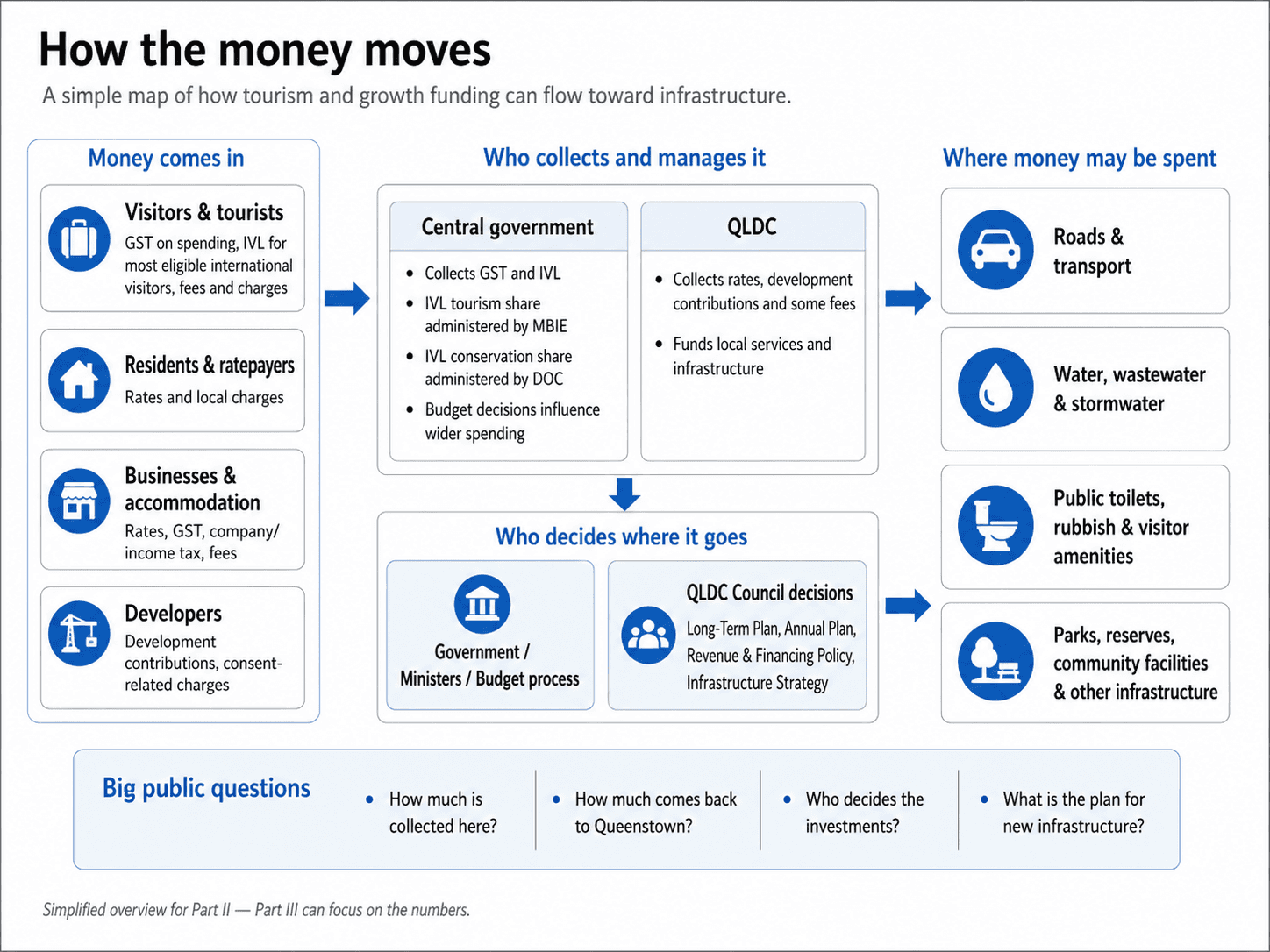
That diagram is deliberately simplified.
We're not pretending we have followed every dollar yet.
That job is still coming.
But before we start throwing numbers around, it helps to understand that Queenstown doesn't have one giant account where all tourism money lands and somebody decides what to do with it.
Money moves through different systems.
And different people make the decisions.
That brings us to another question:
Who decides?
Growth isn't only tourism
This was another useful correction from the community.
Queenstown's infrastructure pressure isn't created by visitors alone.
People raised subdivisions.
Housing development.
Resident population growth.
Construction.
Commuting.
New businesses.
Traffic generated by workers moving across the district.
Several commenters asked whether developers should be contributing more towards the infrastructure required by the growth their developments create.
Others questioned whether infrastructure is being built in the right order.
Do we build first and then try to catch up?
Or should transport, water, community facilities and other infrastructure arrive alongside development?
That's a slightly different argument from tourism funding.
But it's difficult to separate the two in Queenstown.
We have tourism growth and residential growth happening in the same geographically constrained place, relying on much of the same infrastructure.
And that may be where the real story begins.
The cost of success
There is an uncomfortable thing about Queenstown's problem.
People want to come here.
That's the success.
Tourists want to visit.
People want to move here.
Businesses want to operate here.
Developers want to build here.
New Zealand wants tourism to grow.
And Queenstown has become one of the country's most internationally recognised destinations.
That's not failure.
It's success.
But success creates its own pressures.
More visitors need transport, water, wastewater, toilets, rubbish services and public spaces.
More residents need homes, schools, roads, public transport and community infrastructure.
More businesses need workers.
Those workers need somewhere to live.
Housing pushes further out.
Commuting increases.
Traffic follows.
Then we start talking about more roads.
More buses.
Another bridge.
A bigger airport.
More infrastructure.
And, eventually:
Who pays?
Perhaps Queenstown isn't suffering because tourism has failed.
Perhaps we are experiencing something more complicated:
the consequences of succeeding faster than the systems supporting that success can adapt.
Then the conversation followed me into another room
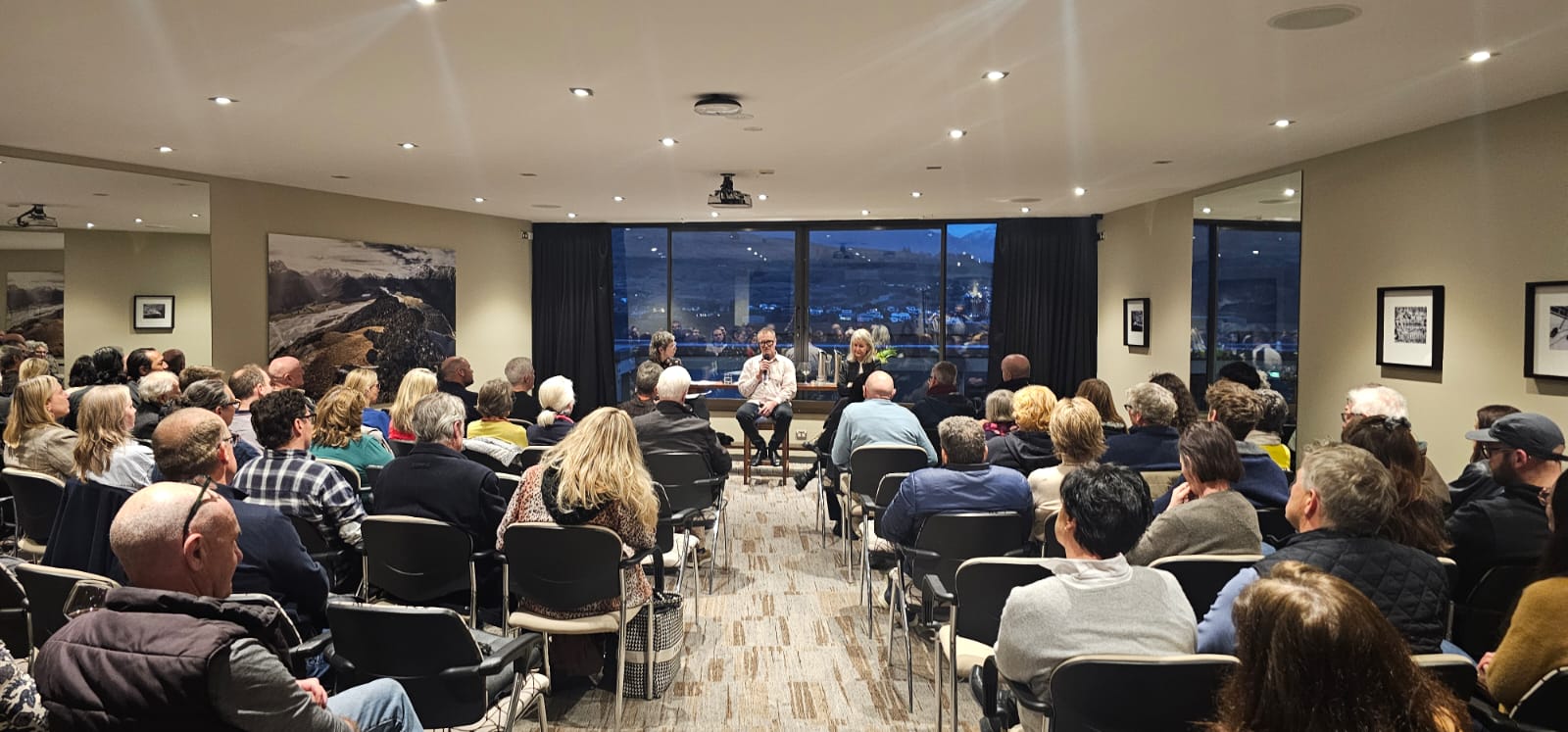
A few days after going through the Facebook discussion, I found myself at The Rees Hotel.
Catalyst Trust had brought together destination-management leader Kiri Goulter, Destination Queenstown and Lake Wānaka Tourism chief executive Mat Woods, with tourism communications specialist Sarah Bennett moderating the conversation.
The subject was the future of tourism - policy, pressures, people and place.
I went in thinking about Who Should Pay for Queenstown?
Pretty quickly I realised the community conversation and the tourism-policy conversation were touching the same problem from different directions.
The national direction is clear.
The Government's Tourism Policy Statement sits alongside a Tourism Growth Roadmap aiming to double the 2023 export value of tourism by 2034. The policy also talks about benefits for businesses, workers and communities and sets out roles across government, local authorities and industry.
Queenstown Lakes, meanwhile, already has its own Travel to a Thriving Future plan, which describes an ambition for regenerative tourism and a carbon-zero visitor economy by 2030 - tourism that generates economic, social, cultural and environmental value rather than simply more volume.
Those ideas don't necessarily contradict each other.
But Queenstown is where the trade-offs become very real.
Grow tourism.
Protect the place.
Support the people who live here.
Build enough infrastructure.
Keep businesses viable.
Maintain a good visitor experience.
And somehow keep all of those things in balance.
Balance
Looking back at my notebook after the event, one word kept appearing.
Balance.
Balance demand and supply.
Tourism growth and residential growth.
Visitors and locals.
Development and infrastructure.
Economic opportunity and the character of the place.
Even the geographical concentration of tourism itself.
One of the ideas I wrote down was whether New Zealand's tourism growth always needs to mean more Queenstown.
There are communities around New Zealand that would welcome more visitors and investment.
Queenstown, meanwhile, already experiences extraordinary concentration.
Perhaps part of sustainable destination management isn't simply asking how to fit more people into successful destinations.
Maybe it's also asking whether demand can be spread more intelligently.
And there was another word all over my notes:
leadership.
Who is steering this?
Before the Catalyst event, Kiri Goulter had put the issue very plainly: New Zealand's tourism system has many players, but she argued there is a governance gap and a need for stronger national and regional coordination from a public-good perspective. Catalyst framed the evening around exactly that question.
That landed differently after reading all those Facebook comments.
Because think about the system.
Central government wants tourism to grow.
Local government manages much of the infrastructure residents and visitors rely on.
Tourism organisations influence demand and destination strategy.
Private businesses respond to markets.
Developers respond to population and housing demand.
Residents experience the consequences on the ground.
And when something stops working, everybody looks around and asks who is responsible.
That might explain why the original question:
Who should pay for Queenstown?
- is proving so difficult.
We may first need to answer:
Who is steering Queenstown's growth?
One thing locals don't want: another bill
There was another message in the Facebook conversation that shouldn't disappear beneath all this policy talk.
Ordinary people have budgets too.
Rates.
Rent or mortgages.
Food.
Fuel.
Childcare.
Insurance.
And everything else that comes with living in Queenstown.
Whatever funding model eventually emerges, several commenters were essentially saying:
don't solve the problem by simply sending another bill to locals.
That's worth remembering.
Especially because those same locals make the tourism economy function.
They work in accommodation.
Restaurants, construction, transport, retail, activities, health, education, council.
Hundreds of other businesses and services.
Queenstown can't have a conversation about tourism sustainability without talking about whether the community supporting tourism can sustainably live here too.
The questions are getting better
After Part I, the community left us with homework.
After Part II, the list is getting longer.
We still need to understand:
How much tourism-related revenue is generated here?
How much of it stays or comes back to Queenstown?
What do ratepayers already contribute?
What do businesses contribute?
What are developers contributing towards growth infrastructure?
What is Queenstown's actual infrastructure funding gap?
What proportion of infrastructure demand comes from resident growth and what proportion comes from tourism?
What new infrastructure is actually planned?
What is funded, what is proposed, and what is still just an idea?
But Catalyst added another layer.
Who coordinates the system?
Who decides what sustainable growth actually means?
How much tourism does Queenstown want?
How much can the place absorb?
And perhaps the simplest question of all:
What do the people who live here actually want tourism to do for their community?
The community gave us homework. Catalyst gave us another question.
This investigation started with money.
Visitors?
Ratepayers?
Businesses?
Developers?
Central government?
But the further we go, the harder it becomes to separate funding from growth, infrastructure and governance.
Queenstown is one of New Zealand's great tourism success stories.
And perhaps that's precisely the challenge.
Success still has to be managed.
A few days ago I thought the next part of this investigation would simply be about following the money.
We're still going to do that.
But first, after sitting in that room at The Rees, there is another question I think we need to examine.
I went to Catalyst thinking about who should pay for Queenstown.
I came out wondering:
Who is actually steering the ship?
That's where Part III begins.
ABOUT THE AUTHOR
Founder & Editor
Cesar Carvajal is a Colombian-born writer, former lawyer and chef who calls Queenstown home. As founder and editor of Queenstowning, he follows the things shaping life around town - development, traffic, infrastructure, community conversations, food, arts, events and the everyday contradictions of living in this little corner of New Zealand. He is also the author of The Older Brother.
View profile →
Enjoyed this story?
Queenstowning is independently built. If you enjoy what we’re creating, you can help keep the stories coming by buying the team a coffee.
Buy the team a coffee ☕
Tag @Queenstowning or use #Queenstowning and show us your version of the Queenstown state of mind.